KSEEB Solutions for Class 6 English Prose Chapter 9 A Rose for the Princess

Students can Download English Lesson 9 A Rose for the Princess Questions and Answers, Summary, Notes Pdf, KSEEB Solutions for Class 6 English Karnataka State Board Solutions help you to revise complete Syllabus and score more marks in your examinations.

Karnataka State Board Class 6 English Prose Chapter 9 A Rose for the Princess

A Rose for the Princess Questions and Answers, Summary, Notes

Comprehension:

1. Answer the following in a word or a sentence each.

Question 1.
Who was the rose a gift for?
Answer:
The rose was a gift for princess Jhanara.

Question 2.
Why does the princess gift silk to Maqbool?
Answer:
The princess was very pleased with the rose Maqbool sent her, so she gifted silk for a jacket for him.

Question 3.
What is the reward Maqbool receives from the princess for taking her out?
Answer:
She gifts him the rose gardens of the quilt to tend for the rest of his life.

Question 4.
What is the request that the princess makes to Maqbool?
Answer:
The princess requested Maqbool to send her the prasad, every time he went to the mandir.

2. Answer the following in 2-3 sentences each:

Question a.
Dilruba tells Maqbool that she belongs to his family. Why does she say this?
Answer:
Dilruba is the name given by Maqbool to one rose plant in the garden. So she says she belongs to his family. Maqbool says that those roses are his only family.

Question b.
What is the condition Maqbool lays down before he agrees to take Panna out with him?
Answer:
Women seeing bangles or attar they will ask for it. Panna should not expect Maqbool to buy that for her as he had no money to buy anything.

Question c.
What explanation does Panna give to explain her statement, “But then the roads were emptied for us.” What is the actual explanation?
Answer:
The actual explanation is that the roads were emptied when the princess made a visit there. She explained that, she accompanied Princess Jahanara and then the roads were emptied.

Question d.
What punishment does the Commander give Maqbool? Why?
Answer:
Maqbool took princess Jahanara to the bustling streets of Agra, so he was asked to leave for Sikandra immediately. For taking Jahanara outside, Maqbool was punished and sent off to work at Akbar Badshah’s tomb at Sikandra.

Question e.
“Because of you, I have had one of the most enjoyable days of my life” Write in your own words why the princess tells Maqbool so.
Answer:
When The Princess visited Agra, the roads were emptied for their visit. So she did not have a chance to see the crowded streets, people walking here Mid there. Now she looked around in wonder and delight. In the Hanuman temple, she rings the bell and eats the prasadam immediately. All this happened because of Maqbool. So she says that she had one of the most enjoyable days of her life.

Question f.
Describe Maqbool’s devotion to tending the garden.
Answer:
Maqbool’s wife died long ago. His sons were in the Emperor’s army and were away with their families in the Deccan. Then the roses were his family. Lovingly he calls each rose by names such as Gulbadan, Badal, Dilruba, and Ghata. He called the pink rose as ‘Subah’ and presented it with decoration to princess Jahanara.

4. Use following phrases in sentences of your own:

Won’t tell a soul, with a glint in her eyes, scrambles to his feet, brand of humor.

  • Sudha promised that she won’t tell a soul about Radha’s failure in the examination.
  • The little girl looked at the new doll with a glint in her eves.
  • As soon as the H.M entered the class, the students scramble to their feet
  • Vijaya has the habit of telling anything with a brand of humor.

5. Match these words with their meaning.

A B
a. tended 1. moved quickly
b. dazed 2. took away forcibly
c. scrambled 3. took care of
d. devastated 4. tost in thoughts
e. abducted 5. extremely shocked or sad.

Answer:
a. 3
b. 4
c. 1
d. 5
e. 2

6. Yesterday you met Radha, a friend of yours. Here are some things Radha said to you. Tell your mother all that Radha said to you.

Stay with me when you come to Bangalore
(Radha asked me to stay with her when I go to Bangalore)

  • I’m living in Bangalore now.
    Radha told me that she was living in Bangalore.then.
  • My father isn’t very well
    Radha said that her father was not very well.
  • My brother and Sita are getting married
    Radha told me that her brother and Sita were getting married.
  • I saw Latha in a party
    Radha said that she had seen Latha at a party.
  • I haven’t seen Mahesh recently.
    Radha said that she hadn’t seen Mahesh recently.
  • I am enjoying my job.
    Radha told me that she was enjoying her job.
  • I bought a new car last month.
    Radha told me that she had bought a new car the previous month.
  • I’ll tell Sita I met you.
    Radha said to me that she would tell Sita that she had met me.

Writing:

7. Write a message to be left for your sister, about a telephone call for her, when she was away. Your message should not exceed 50 words. Put the message in a box.

  • Abhinav: Hello, is it 23455051? Could I speak to Deepthi, please?
  • Pranav: I’m afraid she is not at home.
  • Abhinav: Could you convey to her that Mrs.Srinivasan will be taking maths class tomorrow at 9.00 am? She has to bring her complete project along for submission. The class may go on up to 12 noon.
  • Pranav: I surely will convey the message. By the’ way may I know who is calling?
  • Abhinav: I am Abhinav, Deepthi’s classmate.

Massage:

Dear Sister Deepthi

Abhinav called Mrs. Srinivasan will take Maths class tomorrow at 9.00 A.M. She has asked you to bring a complete project for submission. Classes may go on up to 12 noon.

Love
Pranav

A Rose for the Princess Summary in English

KSEEB Solutions for Class 6 English Prose Chapter 9 A Rose for the Princess 1

Maqbool is a gardener in the gardens of Mughal emperor Shah Jahan. His wife died long ago his sons were in the Emperor’s army and are away with their families in the Deccan. From then onwards the roses were his family. He named every rose like Gulbadan, Badal, Dilruba and Ghata.

One day he sent a rose ‘Subah’ well decorated in a basket to princess Jahanara through Dilruba the maid. In return the princess sent him a silk jacket. The next day when he was digging up a flower fed, another maid by name Panna comes and tells him that she is a maid to Princess Jahanara. Maqbool finishes his digging, sits down with a basket of golden marigolds and begins stringing a garland.

He tells that he is taking that to the Hanumanji mandir. Panna requests Maqbool to take her to the mandir. Maqbool agrees on the condition that he will not buy her anything. He took her to the bustling streets of Agra. Panna looked around in wonder and delight.

The girl walked slowly and stopped everywhere. Panna took the garland from Maqbool and placed it at the feet of the idol. She reached up and rang all the bells and then bent down low to do pranam. The priest gave them prasad and she immediately popped some into her mouth.

Then the two strolled through the bazaar. Panna sat and listened to a man singing on the masjid steps and stood giggling at a funny magician.

She bought roasted chana and sweet potatoes from a street vendor, she stood wide-eyed looking up at the sky, As she was looking at the kite flying high up, soldiers enter with their swords and said that the princess had been kidnapped. Panna revealed her disguise and the commander asked Maqbool to surrender. Princess Jahanara saves him and asks Maqbool to go back to his garden.

The next day Maqbool was sitting sadly in the garden and princess Jahanara came there. Maqbool said that the commander wanted him to leave for Sikandra immediately. Princess Jahanara rewarded Maqbool, the rose gardens of the Qila for the rest of his life and requested him to send her the prasadam whenever he went to the mandir.

A Rose for the Princess Summary in Kannada

KSEEB Solutions for Class 6 English Prose Chapter 9 A Rose for the Princess 2

KSEEB Solutions for Class 6 English Prose Chapter 9 A Rose for the Princess 3

KSEEB Solutions for Class 6 English Prose Chapter 9 A Rose for the Princess 4

KSEEB Solutions for Class 6 English Prose Chapter 9 A Rose for the Princess 5

KSEEB Solutions for Class 6 English Prose Chapter 9 A Rose for the Princess 6

KSEEB Solutions for Class 6 English Prose Chapter 9 A Rose for the Princess 7

KSEEB Solutions for Class 6 English Prose Chapter 9 A Rose for the Princess 8

KSEEB Solutions for Class 6 English Prose Chapter 9 A Rose for the Princess 9

KSEEB Solutions for Class 6 English Prose Chapter 9 A Rose for the Princess 10

KSEEB Solutions for Class 6 English Prose Chapter 9 A Rose for the Princess 11

KSEEB Solutions for Class 6 English Prose Chapter 9 A Rose for the Princess 12

KSEEB Solutions for Class 6 English Prose Chapter 9 A Rose for the Princess 13

KSEEB Solutions for Class 6 English Prose Chapter 9 A Rose for the Princess 14

KSEEB Solutions for Class 6 English Prose Chapter 9 A Rose for the Princess 15

KSEEB Solutions for Class 6 English Prose Chapter 9 A Rose for the Princess 16

KSEEB Solutions for Class 6 English Prose Chapter 9 A Rose for the Princess 17

KSEEB Solutions

KSEEB Solutions for Class 6 Civics Chapter 15 Prabhutva

Students can Download Social Science Civics Chapter 15 Prabhutva Questions and Answers, Notes Pdf, KSEEB Solutions for Class 6 Social Science in Kannada helps you to revise the complete Karnataka State Board Syllabus and score more marks in your examinations.

Karnataka State Syllabus Class 6 Social Science Civics Chapter 15 Prabhutva in Kannada

Class 6 Social Science Prabhutva Text Book Questions and Answers

KSEEB Solutions for Class 6 Civics Chapter 15 Prabhutva 1

KSEEB Solutions for Class 6 Civics Chapter 15 Prabhutva 2

KSEEB Solutions for Class 6 Civics Chapter 13 Pouratva

Students can Download Social Science Civics Chapter 13 Pouratva Questions and Answers, Notes Pdf, KSEEB Solutions for Class 6 Social Science in Kannada helps you to revise the complete Karnataka State Board Syllabus and score more marks in your examinations.

Karnataka State Syllabus Class 6 Social Science Civics Chapter 13 Pouratva in Kannada

Class 6 Social Science Pouratva Text Book Questions and Answers

KSEEB Solutions for Class 6 Civics Chapter 13 Pouratva 1

KSEEB Solutions for Class 6 Civics Chapter 13 Pouratva 2

KSEEB Solutions for Class 6 English Poem Chapter 10 My Heart Leaps Up

Students can Download English Poem 10 My Heart Leaps Up Questions and Answers, Summary, Notes Pdf, KSEEB Solutions for Class 6 English Karnataka State Board Solutions help you to revise complete Syllabus and score more marks in your examinations.

Karnataka State Board Class 6 English Poem Chapter 10 My Heart Leaps Up

My Heart Leaps Up Questions and Answers, Summary, Notes

1. Answer the following questions after sharing your ideas with your partner.

Question a.
The poet says, “My heart leaps up”. Why do you think he feels this way?
Answer:
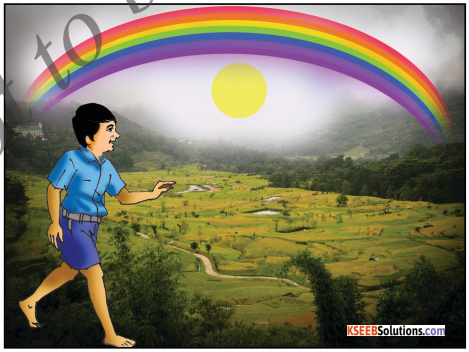
The poet says that his heart leaps up when he sees the rainbow because he is in love with nature and respects and revers it.

KSEEB Solutions

Question b.
When did the speaker have these feelings about the rainbow first?
Answer:
The speaker had these feelings about the rainbow since his birth.

Question c.
Discuss with your partner and write a few sentences on why the poet wants to continue to have these feelings about the rainbow even when he grows old.
Answer:
The poet wants to continue to have these feelings about the rainbow even when he grows old because he likes to be always connected with nature or else he would rather die.

Question d.
What does the poet mean by the term, “natural piety”?
Answer:
The Poet Wordsworth chooses the word ‘natural piety’ to express the bond he wishes to maintain with his childhood. We cherish our habits and hobbies we have cultivated in our childhood and wish to never even give them up in our old age. The poet wants his days to be tied together by reverence and piety of the nature. So it is natural for the poet to be devoted to nature.

KSEEB Solutions

Question e.
The poet shows that life without the ability to see the beauty in Nature is meaningless. Or, he points to how a rainbow brings out the child in us. Do you agree with these statements? Explain.
Answer:
Yes, I agree with the poet. Man is a child of nature. So it is natural for a human being to love the beauties of nature. In the absence of such feelings we are as good as dead.

II. Write a short paragraph (about four sentences) on your experience of seeing a rainbow.

I always feel overwhelmed on seeing a rainbow. It presents a magical sight to me. It makes me wonder at the great mysteries of nature. The spectacular sight of a rainbow makes me feel so small under it. I feel that God created the rainbow to prove that he exists.

KSEEB Solutions

III. Identify the major figure of speech in this poem. Give some similar examples.

The Major figure of speech in the poem is ‘Paradox’ – ‘The child is the father of man’.
A ‘Paradox’ is a statement that sounds absurd or seems to contradict itself but may, in fact, be true.
“What a pity that youth must be wasted on the young”
“Be cruel to be kind”
“Men work together whether they work together or apart” – Robert Frost

My Heart Leaps Up Summary in English

KSEEB Solutions for Class 6 English Poem Chapter 10 My Heart Leaps Up 1

The poem ‘My Heart Leaps Up’ is penned by William Wordsworth. In this poem, the poet is enchanted by his natural surroundings. Being a romantic poet, he is in awe and wonders at nature. He loves and respects nature. Nature is a sacred thing to him.

He says that his heart leaps up when he sees the beautiful and colorful rainbow in the sky. The poet was enamored by the rainbow since his birth. Now he is a young man but still, he is in awe at the rainbow. The poet boldly assures that if his heart does not leap when he sees a rainbow in his old age, he is as good as dead. This means that he will still love nature until he is dead.

He recalls an old adage that says that the child is the father of the man. So habits formed during childhood also never die with old age. He has a great wish that will make him take up each day of his life with the same reference he had for them since his childhood.

He feels blessed by the almighty for having been bom on this beautiful Earth. So he revers each day of his life as a God given gift. So he spends each day of his life in reverence to nature.

KSEEB Solutions

KSEEB Solutions for Class 6 Geography Chapter 21 Africa – Kendriya Bhukhanda

Students can Download Social Science Geography Chapter 21 Africa – Kendriya Bhukhanda Questions and Answers, Notes Pdf, KSEEB Solutions for Class 6 Social Science in Kannada helps you to revise the complete Karnataka State Board Syllabus and score more marks in your examinations.

Karnataka State Syllabus Class 6 Social Science Geography Chapter 21 Africa – Kendriya Bhukhanda in Kannada

Class 6 Social Science Africa – Kendriya Bhukhanda Text Book Questions and Answers

KSEEB Solutions for Class 6 Geography Chapter 21 Africa - Kendriya Bhukhanda 1
KSEEB Solutions for Class 6 Geography Chapter 21 Africa - Kendriya Bhukhanda 2

KSEEB Solutions for Class 6 Geography Chapter 21 Africa - Kendriya Bhukhanda 3
KSEEB Solutions for Class 6 Geography Chapter 21 Africa - Kendriya Bhukhanda 4

KSEEB Solutions for Class 6 Geography Chapter 19 Asia – Vaiparityagala Khanda

Students can Download Social Science Geography Chapter 19 Asia – Vaiparityagala Khanda Questions and Answers, Notes Pdf, KSEEB Solutions for Class 6 Social Science in Kannada helps you to revise the complete Karnataka State Board Syllabus and score more marks in your examinations.

Karnataka State Syllabus Class 6 Social Science Geography Chapter 19 Asia – Vaiparityagala Khanda in Kannada

Class 6 Social Science Asia – Vaiparityagala Khanda Text Book Questions and Answers

KSEEB Solutions for Class 6 Geography Chapter 19 Asia - Vaiparityagala Khanda 1
KSEEB Solutions for Class 6 Geography Chapter 19 Asia - Vaiparityagala Khanda 2

KSEEB Solutions for Class 6 Geography Chapter 19 Asia - Vaiparityagala Khanda 3

KSEEB Solutions for Class 6 Geography Chapter 18 Globe Mattu Nakasegalu

Students can Download Social Science Geography Chapter 18 Globe Mattu Nakasegalu Questions and Answers, Notes Pdf, KSEEB Solutions for Class 6 Social Science in Kannada helps you to revise the complete Karnataka State Board Syllabus and score more marks in your examinations.

Karnataka State Syllabus Class 6 Social Science Geography Chapter 18 Globe Mattu Nakasegalu in Kannada

Class 6 Social Science Globe Mattu Nakasegalu Text Book Questions and Answers

KSEEB Solutions for Class 6 Geography Chapter 18 Globe Mattu Nakasegalu 1
KSEEB Solutions for Class 6 Geography Chapter 18 Globe Mattu Nakasegalu 2

KSEEB Solutions for Class 6 Geography Chapter 18 Globe Mattu Nakasegalu 3
KSEEB Solutions for Class 6 Geography Chapter 18 Globe Mattu Nakasegalu 4

KSEEB Solutions for Class 6 History Chapter 1 Itihasa Parichaya

Students can Download Social Science History Chapter 1 Itihasa Parichaya Questions and Answers, Notes Pdf, KSEEB Solutions for Class 6 Social Science in Kannada helps you to revise the complete Karnataka State Board Syllabus and score more marks in your examinations.

Karnataka State Syllabus Class 6 Social Science History Chapter 1 Itihasa Parichaya in Kannada

Class 6 Social Science Itihasa Parichaya Text Book Questions and Answers

KSEEB Solutions for Class 6 History Chapter 1 Itihasa Parichaya 1
KSEEB Solutions for Class 6 History Chapter 1 Itihasa Parichaya 2

KSEEB Solutions for Class 6 History Chapter 1 Itihasa Parichaya 3

KSEEB Solutions for Class 6 History Chapter 2 Namma Karnataka

Students can Download Social Science History Chapter 2 Namma Karnataka Questions and Answers, Notes Pdf, KSEEB Solutions for Class 6 Social Science in Kannada helps you to revise the complete Karnataka State Board Syllabus and score more marks in your examinations.

Karnataka State Syllabus Class 6 Social Science History Chapter 2 Namma Karnataka in Kannada

Class 6 Social Science Namma Karnataka Text Book Questions and Answers

KSEEB Solutions for Class 6 History Chapter 2 Namma Karnataka 1
KSEEB Solutions for Class 6 History Chapter 2 Namma Karnataka 2

KSEEB Solutions for Class 6 History Chapter 2 Namma Karnataka 3
KSEEB Solutions for Class 6 History Chapter 2 Namma Karnataka 4
KSEEB Solutions for Class 6 History Chapter 2 Namma Karnataka 5

KSEEB Solutions for Class 6 History Chapter 2 Namma Karnataka 6
KSEEB Solutions for Class 6 History Chapter 2 Namma Karnataka 7
KSEEB Solutions for Class 6 History Chapter 2 Namma Karnataka 8
KSEEB Solutions for Class 6 History Chapter 2 Namma Karnataka 9

KSEEB Solutions for Class 6 History Chapter 2 Namma Karnataka 10
KSEEB Solutions for Class 6 History Chapter 2 Namma Karnataka 11
KSEEB Solutions for Class 6 History Chapter 2 Namma Karnataka 12

KSEEB Solutions for Class 6 History Chapter 2 Namma Karnataka 13
KSEEB Solutions for Class 6 History Chapter 2 Namma Karnataka 14
KSEEB Solutions for Class 6 History Chapter 2 Namma Karnataka 15
KSEEB Solutions for Class 6 History Chapter 2 Namma Karnataka 16

KSEEB Solutions for Class 6 History Chapter 2 Namma Karnataka 17
KSEEB Solutions for Class 6 History Chapter 2 Namma Karnataka 18
KSEEB Solutions for Class 6 History Chapter 2 Namma Karnataka 19
KSEEB Solutions for Class 6 History Chapter 2 Namma Karnataka 20

KSEEB Solutions for Class 6 History Chapter 2 Namma Karnataka 21
KSEEB Solutions for Class 6 History Chapter 2 Namma Karnataka 22
KSEEB Solutions for Class 6 History Chapter 2 Namma Karnataka 23

KSEEB Solutions for Class 6 History Chapter 2 Namma Karnataka 24
KSEEB Solutions for Class 6 History Chapter 2 Namma Karnataka 25
KSEEB Solutions for Class 6 History Chapter 2 Namma Karnataka 26
KSEEB Solutions for Class 6 History Chapter 2 Namma Karnataka 27
KSEEB Solutions for Class 6 History Chapter 2 Namma Karnataka 28

KSEEB Solutions for Class 6 History Chapter 2 Namma Karnataka 29
KSEEB Solutions for Class 6 History Chapter 2 Namma Karnataka 30

KSEEB Solutions for Class 6 Social Science Chapter 1 Introduction to History

Students can Download Social Science History Chapter 1 Introduction to History Questions and Answers, Notes Pdf, KSEEB Solutions for Class 6 Social Science helps you to revise the complete Karnataka State Board Syllabus and score more marks in your examinations.

Karnataka State Syllabus Class 6 Social Science History Chapter 1 Introduction to History

Class 6 Social Science Introduction to History Textbook Questions and Answers

I. Fill in the blanks:

  1. The father of history is _______.
  2. _______ established ‘The Asiatic Society’.

Answers:

  1. Herodotus
  2. Sir William Jones

KSEEB Solutions

II. Answer the following in a sentence each:

Question 1.
What is history?
Answer:
The systematic presentation of past events is called History.

Question 2.
Who is the father of history? To which country does he belong to?
Answer:
Herodotus of Greece

Question 3.
Why there cannot be a history without sources?
Answer:
Historical evidences are necessary to be particular and authentic about history. One cannot construct history without sources.

Question 4.
List the historical sources.
Answer:
Literary sources and Archaeological sources.

Question 5.
What are the archaeological sources?
Answer:
The physical remains or runs of the things used or constructed structures in the past are archaeological sources. Eg: coins, inscriptions, monuments.

KSEEB Solutions

Question 6.
Name the historian who studied Indology?
Answer:
‘Sir William Jones’.

III. Discuss in group and answer the question:

Question 1.
Write a note on Abbe Dubois.
Answer:
Abbe Dubois was a French missionary who came to India and settled at Ganjam near Srirangapatna. He adopted the local culture and customs and lived like a sage. The local people called him ‘Dodda Swami’. He wrote a book ‘Hindu manners, Customs and Ceremonies’. In this book he has written about the customs, values, thoughts, festivals and Varnashrama system of India. He returned to France after living here for 24 years.

IV. Match the words in column ‘A’ with the related words in column ‘B’:

A B
1. Kalidasa a. History of India
2. Max Muller b. The Asiatic Society
3. James Mill c. Sacred Book of the East
4. William Jones d. Shakuntala

Answers:

  1. c
  2. d
  3. b
  4. a

KSEEB Solutions

Discuss.

Question 1.
Why do we need history? Discuss.
Answer:
What would have happened if humans did not have memory at all? He would have committed the same mistake again and again. In this case, the progress of human beings is not possible. As human beings need “memory” to progress, so, a society or a nation needs “memory” to progress. It is inevitable. Then what can be assumed as “memory” for a society or a nation? That is “History”! Yes, like “memory” serves human to survive, “History” serves as a “Memory” for a society, state, nation and the whole world.

History is a record of good and wrong decisions, joyful and sorrowful experiences and the difficulties faced by our ancestors. Besides, it warns the future decision-making process.The principles, values and ideologists of our ancestors in the history will be a model and guiding force for their descendants. Their valour, adventures, patriotism and sacrifices will inspire the next generations. Moreover, by introducing our culture and heritage, history arouses the feeling of pride and honour for our nation and the world at large.

Class 6 Social Science Introduction to History Additional Questions and Answers

Question 1.
What is the difference between history and a story?
Answer:
History explains, past events with the accuracy of time, place and person. It tells us the journey of human beings and about his failures and successes.
A story is a fictional narration based on imagination.

KSEEB Solutions

Question 2.
Why is there a need to study history?
Answer:
History is a record of good and wrong decisions, joyful and sorrowful experiences and the difficulties faced by our ancestors. Besides, it warns the future decision-making process. The principles, values and ideologies of our ancestors will be a model and guiding force for their descendants. Their valour, adventures, patriotism and sacrifices will inspire the next generations. By introducing our culture and heritage history arouses the feeling of price and honour for our nation and the world at large.

Question 3.
What are Literary sources?
Answer:
Literacy sources are written or orally conveyed information. Written literature comprises of native and foreign literature. Oral literature comprises of folk songs, stories, ballads, myths and legends. Written literature is constructed by literates but oral literature is created by illiterates.

Question 4.
What is meant by ‘Excavation’.
Answer:
The scientific process involved in digging the earth to obtain the ancient remains or fossils of our ancient people is called Excavation. The excavated relics and fossils are scientifically researched.

Question 5.
Why did British officers try to understand Indian History?
Answer:
The British officers tried to understand the history, traditions, customs, values, beliefs and laws to strengthen their trade relationship.

KSEEB Solutions

Question 6.
Name some European Scholars who have recorded and preserved Indian history.
Answer:
Col. Wilkes, B.L. Rice, Francis Bucchan and Mackenzie

Fill in the blanks :

  1. _______ is the systematic presentation of past events.
  2. History serves as a _______ for a society.
  3. Folk songs, stories, ballads are _______ sources.
  4. Coins, inscriptions, monuments, relics are _______ sources.
  5. There cannot be history without _______.
  6. _______ translated Sanskrit grammer into English.
  7. _______ is known as the Father of History.

Answers:

  1. History
  2. Memory
  3. Oral Literature
  4. Archaeological
  5. Sources
  6. Heinrich Roth
  7. Herodotus

KSEEB Solutions

Match the following:

A B
1. Herodotus a. Literary sources
2. Folksongs, ballads, myths b. Father of History
3. Father Couerdoux c. Study of culture and history of India
4. Indology d. Identified similarities between Sanskrit and European language
5. Max muller e. Abbe Dubois
6. Doddaswami f. Sacred book of the East

Answers:

  1. b
  2. a
  3. d
  4. c
  5. f
  6. e
error: Content is protected !!