KSEEB Solutions for Class 6 English Poem Chapter 7 My People

Students can Download English Poem 7 My People Questions and Answers, Summary, Notes Pdf, KSEEB Solutions for Class 6 English Karnataka State Board Solutions help you to revise complete Syllabus and score more marks in your examinations.

Karnataka State Board Class 6 English Poem Chapter 7 My People

My People Questions and Answers, Summary, Notes

Preparatory activity:

1. a) Write the names of the professions:

  • A person who mends shoes.
    Cobbler
  • A person who stitches clothes.
    Tailor
  • A person who makes ornaments.
    Goldsmith
  • A person who represents people in court.
    Advocate
  • A person who works in the field.
    Farmer
  • A person who sells fruits and vegetables.
    Green Grocer

KSEEB Solutions

b) Do you know any other professions? Write them down and discuss the nature of work.

  • Carpenter – makes furniture,
  • Mason – builds buildings.

Let’s understand:

C1. Answer the following in two or three sentences:

Question 1.
Who are referred to as ‘they’ in the poem?
Answer:
Hard-working skilled laborers of various work are referred to as ‘they’ here.

Question 2.
“They weave cloth, but they go naked”. Why do they weave cloth? Why do they go naked?
Answer:
They weave cloth for people to dress up well but their meager income makes them go naked.

Question 3.
Why do people sigh?
Answer:
After a day-long work, if they return home empty-handed, the people sigh

Question 4.
Who does the poet refer to as God-loving men?
Answer:
Men who pose themselves as Godmen. They preach that all men are equal, but never; try to uplift the poet’s people.

KSEEB Solutions

Question 5.
Is the poet sympathetic to them? How do you know?
Answer:
Yes, the poet is sympathetic to them. Because the poet refers to them as ‘my people’ and highlights the miseries they suffer.

C2. Discuss in small groups and answer the following:

Question 1.
Who is the speaker in the poem? Who is he talking to?
Answer:
Dr. Siddalingayya is the speaker in the poem and he is talking to the people of India.

Question 2.
What, as mentioned in the poem, are the different activities done by them?
Answer:
Carrying stones for buildings, excavating gold. Plowing the field, sowing the seeds, cutting the crops, build shops and raise bungalows, make footwear.

Question 3.
Why does the poet have sympathy for his people?
What, as mentioned in the poem, are the different activities done by them?
Answer:
His people are all hard workers and thy work for the benefit of society. But they suffer from poverty, so he sympathizes with them.

Question 4.
Isn’t it a pity that some people build the shops but get into heavy debts? How does this happen?
Answer:
Even though the poet’s people toil day and night, they are paid a pittance. Many of them can’t offer even a square meal a day because of their meager earnings. They are forced to borrow money from their employer’s for huge interest rates. The employers deduct the loans from their payment and the poet’s people go home empty-handed or borrow again.

KSEEB Solutions

Question 5.
What do you think should be done to solve their miseries?
Answer:
The government should take the responsibility of maintaining the equal status of people in the country. The daily wage workers must be well paid and enjoy all the benefits from the government like the government employees.

Let’s appreciate:

  1. Select and write the five most important words from the poem. Say why you chose those words. Import words from the poem
    • They get kicked until they swoon
    • They weave cloth, but they go naked
    • They cut the crops and they are baked in the sun
    • When they collapse on the street, they don’t cry for help
    • They fall at others’ feet and they get kicked.
  2. The poem highlights the miseries of downtrodden society in our country. India is the only country Where the rich are getting richer and the poor are getting poorer. Most of the rich are not aware of the difficulties olf the, poor. In this way, the poem paves a way for. their clear understanding.

My People Summary in English

Dr. Siddalingaiah is a professor of Kannada in Bangalore university. He is a major Kannada poet. He pioneered the Dalit voice in 1975. The trendsetting work on Dalit literature in Kannada is ‘Holemaadiagana Haadu’ (1975) a collection of poems by Siddalingaiah. His autobiography. ‘Ooru Keri’ is translated into English. Many of his poems are translated into various Indian and other languages.

Dr. Sumathedra Nadig is a prominent modern poet. His ‘Dampatya Gita’ has been translated into English, Hindi, Bengali, and other Indian languages.

In the poet ‘My People’ Dr. Siddalingaiah, the poet highlights the miseries of his people the ‘Dalits’. Dalits have been socially marginalized by others in Indian society. In the days gone by Dalits never had an opportunity to get educated and this led to their oppression.

They were forced to work as landless laborers, paid meagerly, and led a life of poverty. They have suffered unknown miseries. In the poem, the poet says that his people carry stones for buildings.

They are forced to do hard labour. If they are not quick enough to do the work assigned to them they are kicked until they faint. Even though they toil day and night, they are paid a pittance. Many of them can’t afford two square meals a day and so die of hunger or malnutrition.

The poet’s people, go deep into the gold mines, risking their lives and limbs to excavate gold, even though they help to produce the most valuable metal on earth, they don’t get a meal a day, because they are paid a meager wage from their toil.

These people weave cloths to protect the modesty of all people, but they themselves go naked because they can’t afford the clothes they themselves weave. These people plough the fields of rich landlords.

They sow the seeds and harvest the crops by toiling in the hot sun. They get baked (burnt) in the sun – many of these people are enslaved into bonded labour because they have borrowed money from the landlords.

All the money they earn by labouring at the Landlords fields is deducted for the loans they have to repay, so they go home empty-handed. They have a deep sigh in sorrow and live a life of misery and poverty.

These people build shops and raise buildings. They are ensnared in a web of heavy debts. In spite of poverty and starvation, they do not cry out for help when they are in a difficult situation. They suppress their cries for help because they know that no one will help them, no one will come to their aid and relieve them of their misery.

They pay heavy interest for the loans they borrow (they pay interest through their noses). The politicians use them as their vote banks. They make fiery speeches about their upliftment and get elected. These people lured by their enticing promises elect them, only to be let down by the politicians – ‘They become ash in the fire of fiery speeches.

Men often project themselves as God-loving people but these men (Guru’s and math – heads) live a life of luxury. The poet’s people make footwear for these Godmen.

If the poet’s people fall at other’s feet i.e, if they plead for help they are kicked. But they are ignorant of the ways of the other men who assure them of their upliftment. They devote themselves to these men and listen to anything said to them.

But they never get any help, they are left to fend for themselves. They live on air. They live a life of poverty and misery, these people, the poet’s people.

My People Summary in Kannada

KSEEB Solutions for Class 6 English Poem Chapter 7 My People 1
KSEEB Solutions for Class 6 English Poem Chapter 7 My People 2
KSEEB Solutions for Class 6 English Poem Chapter 7 My People 3
KSEEB Solutions for Class 6 English Poem Chapter 7 My People 4
KSEEB Solutions for Class 6 English Poem Chapter 7 My People 5

Glossary:

site: an area that is used for building
swoon: faint
excavate: dig up
weave: make clothing, on a machine
plough: a large tool used by farmers to turn over the soil before planting crops.
sigh: make a noise when you breathe out, often when you are sad.
misery: sadness and suffering
debt: an amount of money that you owe someone
collapse: fall down
suppress: hold back
restrain ash: the soft, grey powder which remains when something is burnt.
devote: use time or energy for a particular purpose

KSEEB Solutions

KSEEB Solutions for Class 6 English Poem Chapter 3 Kindness to Animals

Students can Download English Poem 3 Kindness to Animals Questions and Answers, Summary, Notes Pdf, KSEEB Solutions for Class 6 English Karnataka State Board Solutions help you to revise complete Syllabus and score more marks in your examinations.

Karnataka State Board Class 6 English Poem Chapter 3 Kindness to Animals

Kindness to Animals Questions and Answers, Summary, Notes

Preparatory activity:

Papa is so nice that he gifted me a friend “Rabbit”, a gift none of my friends have. The rabbit is white like cotton and her eyes are beautiful like pomegranate seeds, but a little bigger. She has beautiful long ears. Papa, Amma and I decided to call her “Sweety”.

Amma- takes care of Sweety. Sweety loves to eat carrots and raw vegetables. Amma says vegetables eaten raw after washing, are good. So my friend Sweety and I eat together in the evening.

When I come from school, I see Sweety waiting for me. She jumps on me and I carry her. I kiss her and we play in the small garden we have behind the house. Lots of flowers grow there. It is a very beautiful garden. On Sunday morning, I water the plants.

Uncle Roshan came from Mangaluru. He liked my friend Sweety. When I was playing in the living room, uncle Roshan, who is my father’s friend said, “I have not eaten rabbit meat for a long time.

Can I take it while I go back tomorrow? You all don’t like eating meat and w- don’t get to see rabbits this daada. My family and I will have a feast.” My Papa and Amma became angry but they did not talk. They kept quiet and continued to watch T.V. Uncle Ram got up, went to the table and started doing his office work.

I ran to see where Sweety was. She was playing on the lawn. I immediately carried her to my friend’s house. I asked my friend to keep sweety for a day and said I would collect her the next day. I left some carrots for her too and came home. Since I take care of Sweety, Papa and Amma did not know what I had done.

Early morning, after breakfast, Uncle Ram asked for Sweety. Papa and Amma kept quiet, uncle Ram looked around. Nowhere could he find her. And then he left for Mangaluru. My Sweety is safe forever.
(Source: Reading cards, RIE)

KSEEB Solutions

Listen to the story narrated by your teacher and respond to the following questions:

Question 1.
Who is Sweety?
Answer:
Sweety is a pet ‘Rabbit’.

Question 2.
List the words that describe Sweety.
Answer:
White like cotton eyes beautiful like pomegranate seeds, beautiful long ears, sweet.

Question 3.
What does Sweety love to eat?
Answer:
Sweety loves to eat carrots and raw vegetables.

Question 4.
Fill in the blank:
Answer:
Sweety plays with the girl in the small garden behind the house.

Question 5.
Say True or False
Answer:

  • Uncle Ram wants to play with Sweety. False
  • Sweety was safe in the girl’s friend’s house. True

Listen again and answer the following questions:

Question 1.
Who do you think is telling the story?
Answer:
A little girl.

Question 2.
Why did the narrator leave j Sweety in the friend’s house?
Answer:
Her uncle Roshan wanted to like the rabbit to Mangaluru and eat meat.

Question 3.
What would you do if you were in a similar situation?
Answer:
I would have never let it tp be killed, similarly to the girl in the story.

Question 4.
What would Sweety tell uncle Ram if she could speak? Complete the sentences.
Answer:
Sweety: Uncle Ram, Please don’t kill me. I too have a life like you. I would also like to live and play. Have mercy on me. Please kindly let me live. (would, kill, kindly, let, have). She would have told him to be compassionate towards dumb animals and not to kill them for there meat.

Let’s understand:

C1. Complete the following sentences with the help of the poem:

  1. If we allow the robin to eat his crumbs and meat then he will sing.
  2. If we don’t hurt the hare, she will peep, come, sport and play.
  3. If we allow the little lark to fly high, he will sing.

KSEEB Solutions

C2. Question 1.
When does the robin come to our house?
Answer:
The robin will come to our house if we throw the bread crumbs in the front open space of our house.

Question 2.
When do the hare sport and play?
Answer:
If you don’t hurt the timid hare. It will come, sport and play.

Question 3.
Who flies high robin or lark? Pick out the suitable line from the poem in support of your answer.
Answer:
Lark flies high
“The little lark goes souring high To the bright windows of the sky”.

Question 4.
Pick out the phrases and words where the poet asks us to be kind to animals and birds.
Answer:
Never give pain to things that feel and love
Never hurt the timid hare
Oh! let him sing his happy song Nor do these gentle creatures wrong.

Let’s appreciate it.

Question 1.
Read the poem and find the words that rhyme with:

KSEEB Solutions for Class 6 English Poem Chapter 3 Kindness to Animals 1

Words Rhyming words
give live
play day
sky high
spring wing
song wrong
come home
have lair

Question 2.
In many of the lines in this poem, we find that the same sound is repeated. For example, the sound ‘r’ in “Feeling from her green grass lair”, is repeated.
Answer:
“Never hurt the timid have”
To the bright windows of the sky”
“Singing as if it were always spring
And fluttering on an untired wing.
“Nor do these gentle creatures wrong”.

Question 3.
Work in pairs and find out all the describing words for the following:
KSEEB Solutions for Class 6 English Poem Chapter 3 Kindness to Animals 2
Answer:

Describing Word Naming Word
1. little
2. gentle
3. timid
4. green
5. little
6. bright
7. untired
8. happy
9. gentle
children
robin
hare
grass
lark
window
wing
song
creatures

S1. “It is not right to kill anything without a good reason Discuss. Let’s speak

Man has no authority to kill any living being on earth without a good reason. If the animal in very old and unable to walk and manage itself it can be killed. Sacrificing animals, not a good habit. For ecological balance, it is necessary to kill animals which is doing by carnivorous animals to some extent.

KSEEB Solutions

S2. Sit in groups. Ask 2 or 3 questions on each of the following birds and animals.

  1. Parrot
    • How many kinds of parrots ai-j there?
    • What is the color of the parrot in common?
    • What do parrots eat?
  2. Dog
    • Why is the dog called as a friend of man?
    • Mention any 4 breeds of dog.
    • How are they useful to the ponce department?
  3. Cow
    • What does the cow give us?
    • How many horns does the cow have?
    • The cow is an omnivorous climate. true or False.
  4. Cat
    • What is the use of a cat in a go-down?
    • What do they steal at home?
    • The cat crosses us when we go out. Is it a good omen or a bad omen?
  5. Horse:
    • What are the uses of a horse to a man?
    • What do they eat?
    • How is the horse-drug useful to man?
  6. Lion
    • What is a lion called?
    • What is a group of lions called?
    • Write the feminine gender of a lion?
  7. Crow
    • Where are the crows found?
    • They are called scavengers, True or false
    • How many types of crows do you see generally?

S3. WHO AM !?

Riddles

Listen to the following riddles and guess the name of the bird/ animal/insect (Let one child come to the front of the class and read the riddle. Let other children guess the name of the bird/animal/insect)

Question 1.
I am very, very big. I like to eat peanuts and hay. I have four legs and two big ears. My long nose is called a trunk.
Answer:
I am an Elephant.

Question 2.
I live in the woods. I’m very big and furry. I have a big nose, a little tail, and four legs. I like to eat fish and berries.
Answer:
I am a bear.

KSEEB Solutions

Question 3.
My skin is green and slippery. I have four legs and webbed feet. I eat bugs and little fish. I can swim underwater and hop on land.
Answer:
I am a frog.

Question 4.
I’m a soft and furry pet. I have four legs and a long tail. I have sharp teeth and claws. I like to chase mice.
Answer:
I am a cat.

Question 5.
I have four legs. I’m very smart and I like to play. Hike to smell things. I can wag my tail.
Answer:
I am a dog.

Question 6.
I have a tail. I can fly. I’m covered in colorful feathers. I can thistle and I can talk.
Answer:
I am a Parrot.

Question 7.
I live in the ocean. I like to eat crabs. I can change colors. My eight legs are called tentacles.
Answer:
I am an Octopus.

Question 8.
I am small and shy. I have eight legs. I eat bugs. I catch them in my web.
Answer:
I am a spider.

Question 9.
I live in lakes and rivers. I eat fish and birds. I have four legs and a long tail. I have lots of pretty teeth.
Answer:
I am a crocodile

KSEEB Solutions

Let’s write:

W1. Look at the following picture and try to describe it. There are some questions and some words in the box for your help. Discuss your ideas in small groups and present them to the class.

KSEEB Solutions for Class 6 English Poem Chapter 3 Kindness to Animals 3

Question 1.
What do you see in the sky?
Answer:
Clouds and birds are seen in the sky.

Question 2.
How many boats are there in the sea?
Answer:
There are 2 boats in the sea.

Question 3.
What are the children doing?
Answer:
The children are swimming in the sea. A boy is building sandcastles and a girl is collecting seashells.

Question 4.
What is the girl collecting?
Answer:
The girl is collecting seashells

Question 5.
What is the boy doing?
Answer:
The boy is building a sandcastle.

Question 6.
What are some people drinking?
Answer:
Some people are drinking tender coconuts.

KSEEB Solutions

Write a short paragraph. Give a suitable title to the paragraph that you have written:

This is a picture of a beach. There are 2 boats sailing in the water. 3 girls are enjoying a sea bath. A vendor is pulling his cart with eatables towards the beach. A lady is standing and watching the sea. A boy and a girl are drinking tender coconut. Another small boy is building a sandcastle and a small girl in collecting seashells. Clouds and flying birds are seen above. The sun is peeping from behind the cloud.

Kindness to Animals Summary in English

KSEEB Solutions for Class 6 English Poem Chapter 3 Kindness to Animals 4

“The given poem ‘Kindness to animals’ is penned by an anonymous poet. In the poem, the poet is requesting little children to never give pain to all things that feel and live. He pleads with them to let the gentle robin (a small brown bird marked with red on its breast) to come and eat the crumbs of food that we have saved in our home.

If you allow him to feed on the ‘Meat’ (crumbs), he will be grateful to you, and in return for that favour, he will sing a sweet song to cheer you.

Again the poet pleads the children not to hurt the timid hare, peeping frantically from her green grass lair. He requests the children to allow it to come and play on the lawn during the evening and you can watch it playing and entertain yourself.

The poet gives vivid imagery of a little lark that goes soaring high into the bright sky. It sings cheerfully as if it was spring every day. The little lark is so active that he does not get tired of fluttering and singing all day long.

Hence the poet pleads with the children to let him sing his happy song and never ‘do wrong’ i.e, never hurt or kill these gentle creatures.

Kindness to Animals Summary in Kannada

KSEEB Solutions for Class 6 English Poem Chapter 3 Kindness to Animals 5
KSEEB Solutions for Class 6 English Poem Chapter 3 Kindness to Animals 6
KSEEB Solutions for Class 6 English Poem Chapter 3 Kindness to Animals 7

KSEEB Solutions

KSEEB Solutions for Class 6 English Supplementary Chapter 2 Channapatna Toys

Students can Download English Lesson 2 Channapatna Toys Questions and Answers, Summary, Notes Pdf, KSEEB Solutions for Class 6 English Karnataka State Board Solutions help you to revise complete Syllabus and score more marks in your examinations.

Karnataka State Board Class 6 English Supplementary Chapter 2 Channapatna Toys

Channapatna Toys Questions and Answers, Summary, Notes

Let’s understand:

Answer the following questions briefly:

Question 1.
Which organization is helping the toymakers?
Answer:
‘Maya Organic Organization’ an NGO is helping the toymakers.

KSEEB Solutions

Question 2.
How were the toys made in olden days?
Answer:
The toys were chipped away on a piece of wood in olden days.

Question 3.
How are the toys made in ‘Maya Organic’ now?
Answer:
In Maya Organic workers chip away on power lathes and make toys.

Question 4.
What is the opinion of Mr. Girish about toy making?
Answer:
Chennapatna toys are world-famous. They are protected as a geographical indication under the World Trade Organization. These toys are made out of ‘Aale Mara’.

Question 5.
How did the toy originate in Channapatna?
Answer:
Tipu Sultan loved children very much. He brought Persian toy makes to his kingdom. Persian toymakers trained local artisans. They left this wonderful art in our state.

Question 6.
What channapatna toys?
Answer:
The Channaptna toys are special because vegetable colours are used in them and sent to foreign countries. Channapatna toys have been given Geographical Indication. Under the WTO (World Trade Organisation).

Question 7.
What type of wood is used to make Chahnaptna toys?
Answer:
‘Aale mara’ wood is used to make channapatna toys.

KSEEB Solutions

Question 8.
What is special about the lacquerware craft complex?
Answer:
The government has constructed a lacquerware craft complex on Tattekere road. Training is being given with the help of Karnataka Handloom Development Corporation

Question 9.
What do the toymakers make besides the toys?
Answer:
Cricket bats, wickets, photo frames, trophy bases, spectacle holders, etc.,

Question 10.
How is the Karnataka Government helping the artisans?
Answer:
The Karnataka government is giving training to the artisans. The government has constructed a Lacquerware craft complex. Tatte kere Road.

Lets Practise Words:

a. What are the full forms of the following abbreviations? Find out from a dictionary or from, your friends.

  1. NGO – Non-Government Organisation.
  2. GI – Geographical Indication.
  3. WHO – World Health Organisation.
  4. PIN – Postal Index Number.
  5. WTO – World Trade Organisation.
  6. SSLC – Secondary School Leaving Certificate
  7. KMF – Karnataka Milk Federation.
  8. CM – Chief Minister
  9. PM – Prime Minister
  10. IAS – Indian Administrative Service
  11. KPSC – Karnataka Public Service Commission.

KSEEB Solutions

b. With the help of a dictionary, write down some more short forms/abbreviations and their expansions:

  1. DIG – Director and Inspector General of Police.
  2. KAS – Karnataka Administrative Service.
  3. KSEEB – Karnataka Secondary Education Examination Board.
  4. KPC – Karnataka Power Corporation.
  5. BSNL – Karnataka Power Supply Corporation Limited.
  6. KPTCL – Karnataka Power Supply Corporation Limited.
  7. BESCOM – Bengaluru Electric Supply Company.
  8. IPS – Indian Police service.
  9. KIA – Kempegowda International Airport.
  10. Lt. Gen – Lieutenant General.

Channapatna Toys Summary in English

KSEEB Solutions for Class 6 English Supplementary Chapter 2 Channapatna Toys 1

Introduction:
Channapatna is the name of a small town between Bengaluru and Mysuru. Channapatna is famous for its beautiful and colourful toys. These toys mainly attract children. Janap’ada Loka, a folklore centre, is near Channapatna. Here we can see articles or things used in olden days in farming activities. Kengal Anjaneya Swamy, a beautiful temple, is also near Channapatna.

It is near the home town of our late Chief Minister Mr.Kengal Hanumanthaiah. The temple attracts thousands of devotees from different parts of the state.

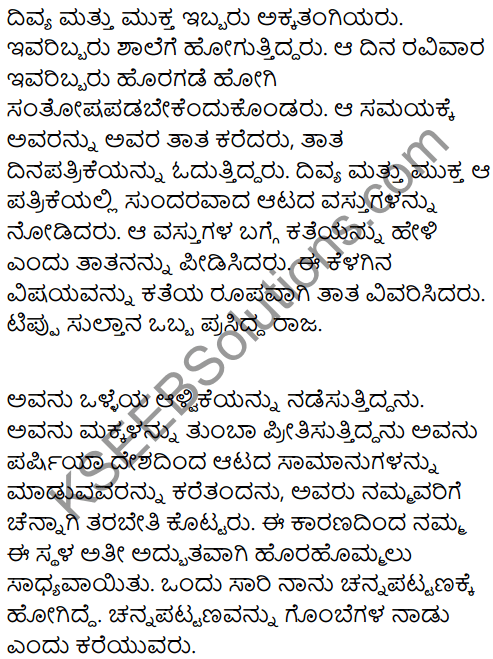
The lesson ‘Channapatna Toys’ is a narrative essay on the town of Channapatna and its glory. Two school-going sisters Divya and Muktha, saw the beautiful pictures of toys in a newspaper their grandpa was reading.

They pestered him to tell them a story about the toys. There Grandpa tells them that Tippu Sulthan was a famous and good ruler. Since he loved children very much, he brought Persian toymakers to his kingdom to teach and train local artisans to make beautiful toys.

Channapatna is also known as ‘Gombegala Ooru’. Once when grandfather had been to Channapatna he visited ‘Maya Organic’ an NGO (Non – Government Organisation. and saw Artisans working hard to earn a living from the wonderful art of making toys. The artisans made toys by chipping away on a piece of wood.

KSEEB Solutions for Class 6 English Supplementary Chapter 2 Channapatna Toys 2

But now – a – days, artishans use power lathes to make toys. Channaptna toys are eco friendly because only .regetable colours are used to colour them. These toys are exported to many countries. The grandfather had also met Mr. Girish, who had eighteen years of toy-making experience. Mr. Girish had told grandpa that they were a family of toymakers and that they made ‘SadaBombe’ (plain toys without colours.

He also told Grandpa that these toys were world-famous and are also protected as a geographical indication (GZ. under WTO (World Trade Organization. (A Geographic Indication (GI. is a sign that identifies a product as originating from a particular location which gives that product a special quality or reputation Eg: Daijelling tea] Channapatna toys are made out of Aale Mara (Ivory, wood. or Wrightia tinctoria tree.

The government of Karnataka is supporting and helping the toymakers. Karnataka State
Handicrafts Development Corporation (KSHDC., conducts toy-making workshops and Training. The government has set up a lacquerware craft complex on Tatte kere Road, Channapatna.

The Channapatna toymakers also make cricket bats, wickets, photo frames, trophy bases and spectacle cases. The Dutch government and the ‘VISHWA’ scheme of the Karnataka Government provide financial assistance to the toymakers.

Other than the colourful toys, Channapatna is famous for.rits Anjaneya Swamy temple at kengal just beside the Bengaluru – Mysore Highway. The former chief minister of Karnataka, Shri. Hanumanthaiah, who hails from kengal, renovated this temple.

Other attractions of Chennaptna are the Janapada Loka near Ramanagara. It is a museum for the folklore, of rural people. Janapadaloka was established by Dr.H.L. NageGowda. Here young village artists are, trained in folk arts.

After listening to their grandpa, the two sisters, Divya and Muktha, decide to visit Channapatna and Ramanagara during the summer vacations.

Channapatna Toys Summary in Kannada

KSEEB Solutions for Class 6 English Supplementary Chapter 2 Channapatna Toys 3
KSEEB Solutions for Class 6 English Supplementary Chapter 2 Channapatna Toys 4.
KSEEB Solutions for Class 6 English Supplementary Chapter 2 Channapatna Toys 5
KSEEB Solutions for Class 6 English Supplementary Chapter 2 Channapatna Toys 6
KSEEB Solutions for Class 6 English Supplementary Chapter 2 Channapatna Toys 7
KSEEB Solutions for Class 6 English Supplementary Chapter 2 Channapatna Toys 8

Glossary:

wonder: surprise
wander: roam
exquisite: very beautiful and delicate
pester: trouble with persistent requests
origin: the point where something begins
NGO: Non – Governmental Organisation
lathe: a machine for shaping pieces of wood by turning them against a cutting tool
foreign: of a country of a language other than your own
lacquerware: a hard glowy varnish
spectacles: a pair of glasses
renovate: restore to a good condition or repair
found: establish, build.

KSEEB Solutions

KSEEB Solutions for Class 6 English Poem Chapter 6 The Way to Succeed

Students can Download English Poem 6 The Way to Succeed Questions and Answers, Summary, Notes Pdf, KSEEB Solutions for Class 6 English Karnataka State Board Solutions help you to revise complete Syllabus and score more marks in your examinations.

Karnataka State Board Class 6 English Poem Chapter 6 The Way to Succeed

The Way to Succeed Questions and Answers, Summary, Notes

Let’s understand:

I. Discuss in pairs and answer the following questions:

Question 1.
“Drive the nails aright boys…” What does the statement mean?
Answer:
Hit the nails with all strength so that it will be firm enough to hold and climb up.

Question 2.
What will happen if one never tries?
Answer:
If one never tries, one will never be able to achieve their goal.

KSEEB Solutions

Question 3.
When should we try and try again?
Answer:
Once you fail to do the work, you should try again and again.

Question 4.
What should one do to reach the top?
Answer:
To reach the top one should first climb the hill.

Question 5.
Why should we try again?
Answer:
If we try again, we will succeed.

Question 6.
What suggestions does the poet give to succeed in life?
Answer:
Though you loose balance often, you must not feel disgraced, instead if you try and try again you will succeed at last.

Question 7.
Say true or false:
Answer:

  1. The poet says that we must wait for the opportunity before doing anything (False)
  2. According to the poet, failure is a stepping stone to success (True)

KSEEB Solutions

Question 8.
Which of the following words/ phrases are related to achieving success in life? Colour them.
KSEEB Solutions for Class 6 English Poem Chapter 6 The Way to Succeed 1
Preserve, work hard, be active, aim high, be positive, be confident.

Question 9.
What do you want to achieve in life? What efforts will you make to achieve this?
Answer:
I want to become a teacher and will study well, to reach the goal and serve society.

II. Match the Idioms with their meanings:

  1. Drive the nail aright: use the opportunity in the right way
  2. Strike while the iron is red: hoping for the best without putting efforts
  3. Standing at the foot, gazing at the sky: have clear aims and vision.

III. Match the column A with B

A B
1. Drive the nail a right a) one must first climb the hill
2. Strike with all your might b) never feel downcast
3. When you have work to do c) hit it on the head
4. To reach the top d) while the iron is red
5. Thought you stumble oft. e) do it with a will
f) you will succeed at last

Answer:

  1. d
  2. c
  3. e
  4. a
  5. f

KSEEB Solutions

IV. Which of the following saying/ proverbs are related to the theme of the poem? Tick them (✓) and say a few sentences about each of them Proverbs related to the poem.

  1. A rolling stone gathers no mass
  2. Where there is a will there is a way (✓)
  3. All that glitters is not gold
  4. Do or Die (✓)
  5. An idle mind is a devil’s workshop
  6. Face is the index of mind
  7. There is no short cut to hard work(✓)
  8. Awake, arise, stop not until you reach your goal. (✓)

Let s Appreciate:

  1. Read the poem and pick out the rhyming words. Write them in your notebook.
    • head – red
    • sky – try
    • will – hill
    • downcast – last
  2. Mime a line from the poem. Let other children guess which line is being mimed.
  3. Read the poem backward (start from the last line).
  4. Suggest some more titles to the poem.
    • “Aim to Succeed”
    • “How to make it to the top”
    • “Try and succeed”

KSEEB Solutions

Extended Activity:

Word Bingo
Write any six action words from the poem you have studied in the boxes below.
KSEEB Solutions for Class 6 English Poem Chapter 6 The Way to Succeed 2

The Way to Succeed Summary in English

KSEEB Solutions for Class 6 English Poem Chapter 6 The Way to Succeed 3
The given poem ‘The way to succeed’ is written by Reverned Norman Macleod (3 June 1812 – 16 June 1872). He was a Scottish clergyman and author. He was a religious man and was largely instrumental in the work of strengthening the Scottish church.

In the poem the poet Norman Mcleod advices young children how to succeed in life. He asks the boys to drive the nail straight by hitting the nail right on its head. The poet means to say that at a very young age one should have a clear goal and aim to achieve it in the correct way. i.e., one should be determined to achieve his goal.

A piece of iron can be shaped into any shape when it red hot. Similarly, the poet advised that one should cultivate good habits and start going towards our goal without any hesitation. One should make a good beginning since a work that is well beginning is half-finished. One should never lose a good opportunity and use it to reach his goal.

The poet advises young children to do their work with a strong will. Those who want to reach the top of a hill, i.e to achieve anything), one should climb up the hill. If we do not try to climb up a hill and stand at the bottom and gaze at the sky we can’t reach the top.

We must first try to climb up the hill. Often we may fail to succeed but we should never lose our hope. We should try and try again. Failure is the stepping stone to success. So if we keep on trying we will succeed at the end.

The Way to Succeed Summary in Kannada

KSEEB Solutions for Class 6 English Poem Chapter 6 The Way to Succeed 4
KSEEB Solutions for Class 6 English Poem Chapter 6 The Way to Succeed 5
KSEEB Solutions for Class 6 English Poem Chapter 6 The Way to Succeed 6

KSEEB Solutions

KSEEB Solutions for Class 6 Physical Education Chapter 1 Meaning of Physical Education and Importance in Kannada

Students can Download Physical Education Chapter 1 Meaning of Physical Education and Importance Questions and Answers, Notes Pdf, KSEEB Solutions for Class 6 Physical Education in Kannada helps you to revise the complete Karnataka State Board Syllabus and score more marks in your examinations.

Karnataka State Syllabus Class 6 Physical Education Chapter 1 Meaning of Physical Education and Importance in Kannada

KSEEB Solutions for Class 6 Physical Education Chapter 1 Meaning of Physical Education and Importance in Kannada 1

error: Content is protected !!