KSEEB Solutions for Class 8 Maths Chapter 8 Linear Equations in One Variable Ex 8.1

Students can Download Maths Chapter 8 Linear Equations in One Variable Ex 8.1 Questions and Answers, Notes Pdf, KSEEB Solutions for Class 8 Maths helps you to revise the complete Karnataka State Board Syllabus and score more marks in your examinations.

Karnataka Board Class 8 Maths Chapter 8 Linear Equations in One Variable Ex 8.1

1. Solve the following:

Question i.
x + 3 = 11
Answer:
x + 3 = 11
x = 11 – 3
x = 8

Question ii.
y – 9 = 21
Answer:
y – 9 = 21
y = 21 + 9
y = 30

Question iii.
10 = z + 3
10 = z + 3 10-3 =z
7 = z or z = 7

Question iv.
\(\frac{3}{11}+x=\frac{9}{11}\)
Answer:
KSEEB Solutions for Class 8 Maths Chapter 8 Linear Equations in One Variable Ex. 8.1 1

Question v.
10x = 30
Answer:
10x = 30
x = \(\frac { 30 }{ 10 }\)
x = 3

Question vi.
\(\frac{s}{7}=4\)
Answer:
\(\frac{s}{7}=4\)
S = 4 × 7
S = 28

Question vii.
\(\frac{3 x}{6}=10\)
Answer:
\(\frac{3 x}{6}=10\)
3x = 10 × 6
3x = 60
x = \(\frac { 60 }{ 3 }\)
x = 20

Question viii.
\(1.6=\frac{x}{1.5}\)
Answer:
\(1.6=\frac{x}{1.5}\)
1.6 × 1.5 = x
2.40 = x
x = 2.4

Question ix.
8x – 8 = 48
Answer:
8x – 8 = 48
8x = 48 + 8
8x = 56
x = \(\frac { 56 }{ 8 }\)
x = 7

Question x.
\(\frac{x}{3}+1=\frac{7}{15}\)
Answer:
KSEEB Solutions for Class 8 Maths Chapter 8 Linear Equations in One Variable Ex. 8.1 2

Question xi.
\(\frac{x}{5}=12\)
Answer:
\(\frac{x}{5}=12\)
x = 12 × 5
x = 60

Question xii.
\(\frac{3 x}{5}=15\)
Answer:
KSEEB Solutions for Class 8 Maths Chapter 8 Linear Equations in One Variable Ex. 8.1 3

Question xiii.
3(x + 6) = 24
Answer:
3(x + 6) = 24
3x+ 18 = 24
3x = 24 – 18
3x = 6
x = \(\frac { 6 }{ 3 }\) = 2

Question xiv.
\(\frac{x}{4}-8=1\)
Answer:
KSEEB Solutions for Class 8 Maths Chapter 8 Linear Equations in One Variable Ex. 8.1 4

Question xv.
3(x+2) – 2(x—1) = 7
Answer:
3(x + 2) – 2(x – 1) = 7
3x + 6 – 2x + 2 = 7
x + 8 = 7 .
x = 7 – 8
x = -1

2. Solve the equations :

Question i.
5x = 3x + 24
Answer:
5x = 3x + 24
2x = 24
x = \(\frac { 24 }{ 2 }\)
x = 12

Question ii.
8t + 5 = 2t – 31
Answer:
8t + 5 = 2t – 31
6t = -36
t = \(\frac { -36 }{ 6 }\)
t = -6

Question iii.
7x -10 = 4x + 11
Answer:
7x – 10 = 4x + 11
7x – 4x = 11 + 10
3x = 21
x = \(\frac { 21 }{ 3}\)
x = 7

Question iv.
4z + 3 = 6 + 2z
Answer:
4z + 3 = 6 + 2z
4z – 2z = 6 – 3
2z = 3

Question v.
2x – 1 = 14 – x
Answer:
2x – 1 = 14 – x
2x + x = 14 + 1
3x = 15
x = \(\frac { 15 }{ 3 }\)
x = 5

Question vi.
6x + 1 = 3(x -1) + 7
Answer:
6x + 1 = 3(x —1) + 7
6x + l =3x-3 + 7
6x + l = 3x + 4
6x – 3x = 4 – 1
3x = 3
x = \(\frac { 3 }{ 3 }\)
x = 1

Question vii.
\(\frac{2 x}{5}-\frac{3}{2}=\frac{x}{2}+1\)
Answer:
KSEEB Solutions for Class 8 Maths Chapter 8 Linear Equations in One Variable Ex. 8.1 5
KSEEB Solutions for Class 8 Maths Chapter 8 Linear Equations in One Variable Ex. 8.1 6

Question viii.
\(\frac{x-3}{5}-2=\frac{2 x}{5}\)
Answer:
KSEEB Solutions for Class 8 Maths Chapter 8 Linear Equations in One Variable Ex. 8.1 7

Question ix.
3(x + 1) = 12 + 4(x – 1)
Answer:
3(x + 1)= 12 + 4(x – 1)
3x + 3 = 12 + 4x – 4
3x + 3 = 4x + 8
3x – 4x = 8 – 3
-x = 5
x = -5

Question x.
2x – 5 = 3(x – 5)
Answer:
2x – 5 = 3(x – 5)
2x – 5 = 3x – 15
2x – 3x = -15 + 5
-x = -10
x= 10

Question xi.
6(1 – 4x) + 7(2 + 5x) = 53
Answer:
6( 1 – 4x) + 7(2 + 5x) = 53
6 – 24x+ 14 + 35x = 53
35x – 24x + 6 + 14 = 53
11x+ 20 = 53
11x = 53 – 20
x = \(\frac { 33 }{ 11 }\)
x = 3

Question xii.
3(x + 6) + 2(x + 3) = 64
Answer:
3(x + 6) + 2(x + 3) = 64
3x + 18 + 2x + 6 = 64
3x + 2x + 18 + 6 = 64
5x + 24 = 64
5x = 64 – 24
5x = 40
x = \(\frac { 40 }{ 5 }\)
∴ x = 8

Question xiii.
\(\frac{2 m}{3}+8=\frac{m}{2}-1\)
Answer:
KSEEB Solutions for Class 8 Maths Chapter 8 Linear Equations in One Variable Ex. 8.1 8

Question xiv.
\(\frac{3}{4}(x-1)=(x-3)\)
Answer:
\(\frac{3}{4}(x-1)=(x-3)\)
3(x – 1) = 4(x – 3)
3x – 3 = 4x – 12
3x – 4x = -12 + 3
-x = -9
x = 9

KSEEB Solutions for Class 8 Maths Chapter 6 Theorems on Triangles Ex 6.3

Students can Download Maths Chapter 6 Theorems on Triangles Ex 6.3 Questions and Answers, Notes Pdf, KSEEB Solutions for Class 8 Maths helps you to revise the complete Karnataka State Board Syllabus and score more marks in your examinations.

Karnataka Board Class 8 Maths Chapter 6 Theorems on Triangles Ex 6.3

Question 1.
The exterior angles obtained on producing the base of a triangle both ways are 104° and 136°. Find the angles of the triangle.
Answer:
In triangle ABC, BC is produced on either sides.
Let ∠ABC = 140° and ∠ACE = 136°
∠ABD +∠ABC = 180° [ Linear pair]
104 + ∠ABC = 180°
∠ABC = 180 – 104
∠ ABC = 76°
KSEEB Solutions for Class 8 Maths Chapter 6 Theorems on Triangles Ex 6.3 1
∠ACB + ∠ACE = 180° [Linearpair]
∠ACB + 136° = 180°
∠ACB = 180 – 136 ∠ACB = 44°
∠ABD + ∠ACB + ∠BAC = 180°
[Sum of the angles of a triangle 180° ]
76 + 44 + ∠BAC = 180°
120 + ∠BAC = 180°
∠BAC = 180 – 120 ∠BAC = 60°
Three angles are 76°, 44° & 60°

Question 2.
Sides BC, CA and AB of a triangle ABC are produced in order, forming exterior angles ∠ACD, ∠BAE, and∠CBF.
Show that ∠ACD + ∠BAE + ∠CBF = 360°.
Answer:
KSEEB Solutions for Class 8 Maths Chapter 6 Theorems on Triangles Ex 6.3 2
ABC + ∠CBF = 180° [Linear pair]………..(i)
∠ACB + ∠ACD = 180° [Linear pair]……(ii)
∠BAC + ∠BAE = 180° [Linear pair]…….(iii)
Byadding(i), (ii) and (iii)
∠ABC + ∠CBF + ∠ACB + ∠ACD+
∠BAC + ∠BAE = 180 + 180 + 180
∠ABC + ∠ACB + ∠BAC +
∠CBF + ∠ACD + ∠BAE = 540°
180 + ∠CBF + ∠ACD + ∠BAE = 540°
[Sum of the angles of a triangle 180°]
∠CBF + ∠ACD + ∠BAE = 360°

Question 3
Compute the value of x in each of the following figures
Answer:
i.
KSEEB Solutions for Class 8 Maths Chapter 6 Theorems on Triangles Ex 6.3 3
AB = AC
∴ ∠ABC = ∠ACB = 50°
∠ACB + ∠ACD = 180° [Linear pair]
50 + x = 180°
x = 180 – 50 = 130°

ii.
KSEEB Solutions for Class 8 Maths Chapter 6 Theorems on Triangles Ex 6.3 4
∠ABC + ∠CBF = 180° [Linear pair].
106°+∠ABC = 180°
∠ABC = 180 – 106 = 74°
∠EAC = ∠ABC + ∠ACB
130° =74 +x
130 – 74 = x
∴x = 56°

iii.
KSEEB Solutions for Class 8 Maths Chapter 6 Theorems on Triangles Ex 6.3 5
∠QPR = ∠TPU = 65°
[Vertically opposite angles]
∠PRS = ∠PQR + ∠QPR [Exterior angle=Sum of interior opposire angle]
100 = 65 + x
100 – 65 = x
35 = x
∴ x = 35°.
iv.
KSEEB Solutions for Class 8 Maths Chapter 6 Theorems on Triangles Ex 6.3 6
∠BAE + ∠BAC = 180° [Linear pair]
120° + ∠BAC = 180°
∠BAC = 180 – 120
∠BAC = 60°
∠ACD = ∠BAC + ∠ABC
[Exterior angle = Sum of interior opposuite angle]
112° = 60+x
112 – 60 = x
52 = x
x = 52°
v.
KSEEB Solutions for Class 8 Maths Chapter 6 Theorems on Triangles Ex 6.3 7
In Δ ABC, BA = BC (data)
∴ ∠BAC = ∠BCA = 20°
[Base angles of an isosceles traingle]
∠ABD = ∠BAC + ∠BCA
[Exterior angle=Sum of interior opposite angle]
x = 20 + 20
x=40°

Question 4.
In figure QT ⊥ PR, ∠TOR = 40° and ∠SPR = 30° find ∠TRS and ∠PSQ.
KSEEB Solutions for Class 8 Maths Chapter 6 Theorems on Triangles Ex 6.3 8
Answer:
In ΔTQR,
∠TQR + ∠QTR + ∠TRQ = 180°
40 + 90 + ∠TRQ = 180°
130 + ∠TRQ = 180
∠ TRQ = 180 – 130
∠ TRQ = 50°
∠ TRS = 50° [∠PRS is same as ∠TRS ]
In Δ PRS, RS is produced to Q
∴Exterior∠PSQ = ∠SPR + ∠PRS = 30 + 50
∠PSQ = 80°

Question 5.
An exterior angle of a triangle is 120° and one of the interior opposite angle is 30 °. Find the other angles of the triangle.
Answer:
KSEEB Solutions for Class 8 Maths Chapter 6 Theorems on Triangles Ex 6.3 9
In Δ ABC, BC is produced to D. Let
∠ACD = 120° and ∠ABC = 30°
Exterior ∠ACD = ∠BAC + ∠ABC
120 = ∠BAC + 30
120 – 30 = ∠BAC
90° = ∠BAC
∴∠BAC = 90
∠ACB +∠ACD = 180° [Linear pair]
∠ACB + 120 = 180°
∠ACB = 180 – 120
∠ACB = 60°
Other two angles are 90° & 60°

KSEEB Solutions for Class 8 Maths Chapter 16 Mensuration Ex 16.2

Students can Download Maths Chapter 16 Mensuration Ex 16.2 Questions and Answers, Notes Pdf, KSEEB Solutions for Class 8 Maths helps you to revise the complete Karnataka State Board Syllabus and score more marks in your examinations.

Karnataka Board Class 8 Maths Chapter 16 Mensuration Ex 16.2

Question 1.
Find the total surface area and volume of a cube whose length is 12 cm.
Answer:
l = 12 cm
T.S.A of cube = 6 l² = 6 x 12² = 6 x 144 = 864 cm²
Volume of cube = P = (12)3 = 1728 cm3

Question 2.
Find the volume of a cube whose surface area is 486 cm².
Answer:
T.S.A of a cube = 486 cm²
612 = 486
l² = \(\frac{486}{6}\)
l² = 81
∴ l = √81 = 9 cm
Volume = l3 = 93= 729 cm3

Question 3.
A tank, which is cuboidal in shape has a volume 6.4m3. The length and breadth of the base are 2m and 1.6m respectively. Find the depth of the tank.
Answer:
V = 6.4 m3
l = 2 m
b = 1.6 m
h = ?
Volume of cuboid = 6.4 m3
l × b × h = 6.4
2 × 1.6 × h = 6.4
3.2h = 6.4
h = \(\frac{6.4}{3.2}\)
h = 2m
h = 2m .
∴ The depth of the tank is 2 m.

Question 4.
How many m3 of soil has to be excavated from a rectangular well 28cm deep and whose base dimensions are 10cm and 8m. Also, find the cost of plastering its vertical walls at the rate of Rs. 15/m2.
Answer:
l = 10 m
b = 8
h = 28 m
Volume of soil = volume of cuboid
= l × b × h = 10 × 8 × 28 = 2240 m3
2240 m3 of soil has to be excavated.
Area to be plastered = L.S.A of cuboid
= 2h(l + b)
= 2 × 28(10 + 8)
= 56 × 18
= 1008 m2
The cost of plastering 1m² = Rs. 15
∴ The cost of plastering = 15 × 1008 = Rs. 15,120

Question 5.
A solid cubical box of fine wood costs Rs. 256 at the rate of Rs. 500/m3. Find its volume and length of each side.
Answer:
The cost of Rs. 500 is for 1m3.
The cost of Rs. 256 is for
\(\frac{256}{500}=\frac{128}{250}=\frac{64}{125} \mathrm{m}^{3}\)
∴ Volume of the wood = \(\frac{64}{125} \mathrm{m}^{3}\) = 0.512 m3
Volume = 0.512m
l3 = 0.512
\(l=\sqrt[3]{0.512}\)
l = 0.8 m²
= 0.8 × 100
Length of the side = 80cm, l= 80cm

KSEEB Solutions for Class 8 Maths Chapter 11 Congruency of Triangles Ex 11.3

Students can Download Maths Chapter 11 Congruency of Triangles Ex 11.3 Questions and Answers, Notes Pdf, KSEEB Solutions for Class 8 Maths helps you to revise the complete Karnataka State Board Syllabus and score more marks in your examinations.

Karnataka Board Class 8 Maths Chapter 11 Congruency of Triangles Ex 11.3

Question 1.
In a Δ ABC, AB = AC andlA.= 50° find ∠B and ∠C.
Answer:
∠A+ ∠B + ∠C = 180°
(Sum of the angles of a triangle is 180° )
50 +∠[B + ∠B = 180°
∠B = ∠C Base angles of an isosceles triangle
50 + 2∠B= 180°
2∠B = 180 – 50
2∠B = 130°
∠B = \(\frac{130^{\circ}}{2}\)
∠B = 65°
∠B = ∠C = 65°

Question 2.
In AABC,AB = BCand|B = 64°find|£,
Answer:
AB = BC [data]
∴ ∠C = ∠A [Theorem 1]
∠A + ∠B + ∠C = 180°
(Sum of the angles of a triangle is 180°)
∠C + 64 + ∠C = 180° [∠A = ∠C]
64 + 2∠C = 180°
2∠C = 180 – 64
2∠C = 116
∠C = \(\frac { 116 }{ 2 }\) = 58°

Question 3.
In each of the following figure find the value of x :
i.
KSEEB Solutions for Class 8 Maths Chapter 11 Congruency of Triangles Ex. 11.3 1
Answer:
In ∆ABC, AB = AC
∴ ∠ABC = ∠ACB
∴ ∠BAC + ∠ABC + ∠ACB = 180°
(Sum of the angles of a triangle is 180°)
40 + ∠ABC + ∠ABC = 180°
(∠ABC =∠ACB)
40 + 2∠ABC = 180°
2∠ABC = 180 – 40
2∠ABC = 140°
∠ABC = 70°
∠ACB = ∠ ABC = 70°
∠ACB + ∠ACD = 180°
70 + x = 180°
x = 180 – 70
x = 110°

ii
KSEEB Solutions for Class 8 Maths Chapter 11 Congruency of Triangles Ex. 11.3 2
AC = CD
∠CAD = ∠CDA
∠CAD = ∠CAD = 30°
∠ACD + ∠CAD + ∠CDA = 180°
(Sum of the angles of a triangle is 180°)
∠ACD + 30 + 30=180°
∠ACD + 60=180°
∠ACD = 180-60
∠ACD = 120°
∠ACD = ∠BAC + ∠ABC
120 = 65° + x
120 – 65 = x
55 = x
x=55°

iiii
KSEEB Solutions for Class 8 Maths Chapter 11 Congruency of Triangles Ex. 11.3 3
Answer:
AB = AC
∠ABC = ∠ACB = 55° [Theorem l]
Exterior ∠APB = ∠DAC +∠ACD
75 = x + 55
75 – 55 = x
20 = x
x = 20°

iv.
KSEEB Solutions for Class 8 Maths Chapter 11 Congruency of Triangles Ex. 11.3 4
BD = DC = Ad
BD = DC = AD & ∠ABD = 50 °
∠ABD = ∠BAD(Th. l)
∠BAD = 50°
∠ABD + ∠BAD + ∠ADB = 180°
50 + 50 +∠ADB = 180°
∠ADB = 180 – 100 = 80°
∠APB = 80°
∴ ∠APB +∠ADC = 180°
80 +∠ADC = 180°
∠ADC = 100°
Now AD = DC
∴∠DAC = ∠DCA = x°
∴ x + x +∠ADC = 180°
2x + 100 = 180°
2x = 180-100=80°
x=40°

Question 4.
Suppose ABC is an equilateral triangle. Its base BC is produced to D such that BC = CD.
Calculate: l.∠ACD
2.∠ADC
Answer:
∠ABC = ∠ACB = ∠BAC = 60°
(ABC is an equilateral triangle)
∠ACB +∠ACD = 180° (Linearpoint)
60 + ∠ACD = 180°
∠ACD = 180 – 60
∠ACD = 120°
KSEEB Solutions for Class 8 Maths Chapter 11 Congruency of Triangles Ex. 11.3 5
In ∆ACD,AC=CD
∠ CAD = ∠CPA (Theorem l)
∠ACB +∠ACD = 180° [linear pair]
60° +∠ACD = 180°
∠ACD = 180° – 60° = 120°
∠ACA +∠CAD + ∠CDA = 180°
2∠CDA = 180 – 120°
2∠CDA = 60°
∠CDA = \(\frac { 60 }{ 2 }\) = 30°
∠CDA = 30

Question 5.
Show that the perpendicular drawn from the vertices of the base of an isosceles triangle to the opposite sides are equal. ,
Answer:
Data : In ∆ABC, AB = AC,
BD ⊥AC & CE⊥ AB
To prove : BD = CE
KSEEB Solutions for Class 8 Maths Chapter 11 Congruency of Triangles Ex. 11.3 6
Proof:
In ∆ABC, AB = AC [data]
∠ABC = ∠ACB [Theorem l]
In ∆EBC and ∆DCB
∠EBC =∠DCB( Base angles )
∠BEC = ∠CDB [= 90° ]
BC = BC (Common side)
∆EBC = ∆DCB [ASA postulate]
BD = CE [Corresponding sides]

Question 6.
Prove that an ∆ABC is an isosceles triangle if the altitude AD from A on BC bisects BC.
Answer:
In ∆ADB and ∆ADC
AD = AD [Common side]
∠APB =∠ ADC [90° ]
KSEEB Solutions for Class 8 Maths Chapter 11 Congruency of Triangles Ex. 11.3 7
BD = DC [AD bisects BC]
∴∆ADB ≅ ∆ADC [SAS postulate]
∴AB = AC [Correspondingsides]
∴∆ ABC is an isosceles triangle

Question 7.
Suppose a triangle is equilateral, prove that it is equiangular.
Answer:
KSEEB Solutions for Class 8 Maths Chapter 11 Congruency of Triangles Ex. 11.3 8
To prove: ∠A = ∠B = ∠C
Proof: In ∆ABC, AB = BC
∠C = ∠B [Theorem l]….(i)
BC = AC
∠A =∠B [Theorem l]…(ii)
From (i) and (ii)
∠A =∠B = ∠C
∆ABC is equiangular

KSEEB Solutions for Class 8 Maths Chapter 1 Playing with Numbers Ex 1.1

Students can Download Maths Chapter 1 Playing with Numbers Ex 1.1 Questions and Answers, Notes Pdf, KSEEB Solutions for Class 8 Maths helps you to revise the complete Karnataka State Board Syllabus and score more marks in your examinations.

Karnataka Board Class 8 Maths Chapter 1 Playing with Numbers Ex 1.1

Question 1.
Write the following numbers in generalized form 39, 52, 106, 359, 628, 3458, 9502, 7000.
Answer:
39 = 30 + 9 = (3 × 10) + (9 × 1)
52 = 50 +2 = (5 × 10) + (2 × 1)
106 = 100 + 6 = (1 × 100) + (0 × 10)+(6 × 1) 359 = 300 + 50 + 9 = (3 × 100) + (5 × 10) + (9 × 1)
628 = 600 + 20 + 8 = (6 × 100) + (2 × 10) + (8 × 1)
3458 = 3000 + 400 + 50 + 8 = (3 × 1000) + (4 × 100) + (5 × 10) + (8 × 1)
9502 = 9000 + 500 + 2 = (9 × 1000) + (5 × 100) + (0 × 10) + (2 × 1)
7000 = 7000 + 0 + 0 + 0 = (7 × 1000) + (1 × 100) + (0 × 10) + (0 × 1)

Question 2.
Write the following in the decimal form.
(i) (5 × 10) + (6 × 1);
(ii) (7 × 100)+ (5 × 10)+ (8 × 1);
(iii) (6 × 1000) + (5 × 10) + (8 × 1);
(iv) (7 × 1000) + (6 × 1);
(v) (1 × 1000) + (1 × 10);
Answer:
(i) (5 × 10) + (6 × 1);
50 + 6 = 56

(ii) (7 × 100) + (5 × 10)+ (8 × 1);
700 + 50 + 8 = 758

(iii) (6 × 1000) + (5 × 10) + (8 × 1);
6000 + 50 + 8 = 6058

(iv) (7 × 1000) + (6 × 1);
7000 + 6 = 7006

(v) (1 × 1000) + (1 × 10);
1000 + 10 = 1010

KSEEB Solutions for Class 8 Maths Chapter 16 Mensuration Ex 16.1

Students can Download Maths Chapter 16 Mensuration Ex 16.1 Questions and Answers, Notes Pdf, KSEEB Solutions for Class 8 Maths helps you to revise the complete Karnataka State Board Syllabus and score more marks in your examinations.

Karnataka Board Class 8 Maths Chapter 16 Mensuration Ex 16.1

Question 1.
Find the total surface area of a cuboid with l= 4m, b = 3m and h = 1.5 m
Answer:
T.S.A = 2 (lb + bh + lh)
= 2(4 × 3 + 3 × 1.5 + 1.5 × 4)
= 2(12 + 4.5 + 6)
= 2(22.5)
T.S.A = 45 m²

Question 2.
Find the area of four walls of a room whose length is 3.5m, breath 2.5m and height is 3m.
Answer:
L = 3.5m, b = 2.5m, h = 3m
Area of the 4 walls = L.S.A of cuboid
= 2h(l + b)
= 2 × 3(3.5 + 2.5)
= 6(6) = 36m²

Question 3.
The dimensions of a room are l = 8m, b = 5m and h = 4m. Find the cost of distempering its four walls at the rate of 40/m2.
Answer:
L.S.A of cuboid = 2h (l + b)
= 2 × 4 (8 + 5) = 8 (13)
L.S.A = 104 m²
The cost of distempering 1 m² = Rs 40
The cost of distempering 104m² = 104 × 40 = Rs. 4160.

Question 4.
A room is 4.8m long, 3.6m broad and 2m high. Find the cost of laying tiles on its floor and its four walls at the rate of 100/m²
Answer:
L = 4.8m, b = 3.6m , h = 2m
Required area = Area of the floor + L.S.A of cuboid
= lb + 2h(l + b)
= 4.8 × 3.6 + 2 × 2(4.8 + 3.6)
= 17.28 + 33.6 = 50.88 m²
The cost of laying tiles for 1m² = Rs 100
The cost of laying tiles for 50.88 m² = 50.88 × 100 = Rs. 5088

Question 5.
A closed box is 40 cm long, 50 cm wide and 60 deep. Find the area of the foil needed for covering it.
Answer:
L = 40 cm, b = 50cm, h = 60 cm
Area of the foil = T.S. A of cuboid
= 2 (lb + bh + lh)
= 2(40 × 50 + 50 × 60 + 60 × 40)
= 2(7400)= 14,800 cm²
Area of the foil required 14,800 cm²

Question 6.
The total surface area of a cube is 384 cm2 calculate the side of the cube.
Answer:
T.S.A of cube = 384 cm²
61² = 384
l² = \(x=\frac{384}{6}\)
l² = 64
l = √64
l = 8cm

Question 7.
The L.S.A of a cube is 64m², calculate the side of the cube.
Answer:
L.S.A of cube = 41²
64 = 41²
\(x=\frac{64}{4}\) = l²
∴ l = √16 = 4m
The side of the cube is 4m.

Question 8.
Find the cost of whitewashing the four walls of a cubical room of side 4m at the rate of Rs.20/m2.
Answer:
l = 4m
Area to be whitewashed
= L.S.A of the cube
= 4l² = 4 × 4² = 4 × 16 = 64 m²
cost of whitewashing 1m² = 20
∴ The cost of whitewashing 64m² = 64 × 20 = Rs. 1280.

Question 9.
A cubical box has edge 10cm and another cuboidal box is 12.5 cm long, 10cm wide and 8cm high
i. Which box has a smaller total surface area?
ii. If each edge of the cube is doubled, how many times will its T.S.A increase?
Answer:
T.S.A of cube 61²= 6 × 10² = 6 ×100 = 600 cm²
T.S.A of a cuboid 61² = 6 × 102 = 6 x 100 = 600 cm²
T.S.A of a cuboid = 2(lb + bh + Ih)
= 2[12.5 x 10 +10 x 8 + 8 x 12.5]
= 2[125 + 80 + 100]
= 2[305]
t = 610 cm²
1. The cubical box has smaller total surface area.
2. If the side of the cube is doubled its side will be 20cm.
T.S.A 6l² = 6 × 202 = 6 × 400 = 2400 cm²
original area = 600cm²
\(\frac { 2400 }{ 600 }\) = 4
∴ Its area will increase by 4 times

KSEEB Solutions for Class 8 Maths Chapter 6 Theorems on Triangles Ex 6.2

Students can Download Maths Chapter 6 Theorems on Triangles Ex 6.2 Questions and Answers, Notes Pdf, KSEEB Solutions for Class 8 Maths helps you to revise the complete Karnataka State Board Syllabus and score more marks in your examinations.

Karnataka Board Class 8 Maths Chapter 6 Theorems on Triangles Ex 6.2

Question 1.
In a triangle ABC, if ∠A= 55° and∠B.= 40° find ∠C
Answer:
∠A +∠B + ∠C = 180°
[Sum of the angles of a triangle 180°]
55 + 40 + ∠C = 180°
95 + ∠C = 180“
∠C = 180 – 95
∠C = 85°

Question 2.
In a right-angled triangle, if one of the other two angles is 35°, find the remaining angle.
Answer:
Let the angles be ∠A, ∠B and ∠C
Then ∠A = 90°,∠B = 35° and ∠C = ?
∠A + ∠B + ∠C = 180°
90 + 35 + ∠C = 180°
125 + ∠C = 180
∠C = 180 – 125 = 55°
∠C = 55°

Question 3.
If the vertex angle of an isosceles triangle is 50° find the other two angles.
Answer:
In an isosceles triangle, the base angles are equal, Let the each base angle be ‘x’
∠A + ∠B + ∠C = l80°
50 + x + x = 180°
[Sum of the angles of a traingle 180°]
50 + 2x = 180
2x = 180 – 50
2x = 130
x = \(\frac{130}{2}\)
x = 65°
∴ The other two angles are equal to 65° & 65°

Question 4.
The angles of a triangle are in the ratio 1: 2 : 3. Determine the three angles.
Answer:
Let the common ratio be ‘x’
The three angles are x, 2x and 3x
x + 2x + 3x = 180°
[Sum of the angles of a triangle 180°]
6x = 180°
x = \(\frac{180}{6}\) = 30
x = 30°
2x = 2 × 30 = 60°
3x = 3 × 30 = 90°
∴ The angles are 30°, 60° and 90°

Question 5.
In the adjacent triangle ABC, find the value of x and calculate the measure of all the angles of the triangle.
Answer:
∠A + ∠B + ∠C = 180°
[Sum of the angles of a triangle 180°]
x + 15 + x – 15 + x + 30 = 180°
3x + 30 = 180°
3x = 180° – 30
3x = 150
x = \(\frac{150}{3}\) = 50°
∠A = x +15 = 50 + 15 = 65°
∠B = x – 15 = 50 – 15 = 35°
∠C = x + 30 = 50 + 30 = 80°
∴ The angles are 65°, 3 5° and 80°

Question 6.
The angles of a triangle are arranged in ascending order of their magnitude. If the difference between two consecutive angles is 10° find the three angles.
Answer:
Let the first angle be x, second angle is x + 10° and third angle is x + 20
x + x + 10 + x + 20 = 180°
[Sum of the angles of a triangle 180°]
3x + 30 = 180°
3x = 180 – 30
3x = 150°
x = \(\frac{150}{3}\) = 50°
x = 50°
∴ First angle x = 50°
Second angle = x + 10 = 50 + 10 = 60°
Third angle = x + 20 = 50 + 20 = 70°
Three angles are 50°, 60° & 70°

KSEEB Solutions for Class 8 Maths Chapter 6 Theorems on Triangles Ex 6.1

Students can Download Maths Chapter 6 Theorems on Triangles Ex 6.1 Questions and Answers, Notes Pdf, KSEEB Solutions for Class 8 Maths helps you to revise the complete Karnataka State Board Syllabus and score more marks in your examinations.

Karnataka Board Class 8 Maths Chapter 6 Theorems on Triangles Ex 6.1

Question 1.
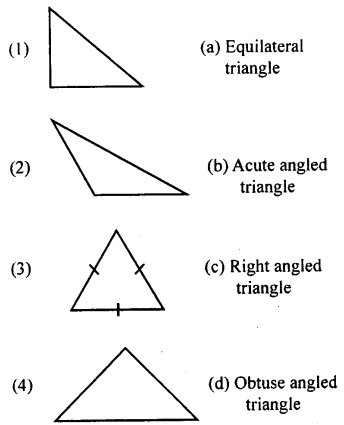
Match the following
KSEEB Solutions for Class 8 Maths Chapter 6 Theorems on Triangles Ex 6.1 1
Answer:
1 – c
2 – d
3 – a
4 – b.

Question 2.
Based on the sides, classify the following triangles (figures not drawn of the scales)
KSEEB Solutions for Class 8 Maths Chapter 6 Theorems on Triangles Ex 6.1 2
Answer:
Equilateral triangle (viii)
Isosceles triangle (iv), (ix), (x)
Scalene triangle (i), (ii), (iii), (v), (vi), (vii).

KSEEB Solutions for Class 8 Maths Chapter 13 Statistics Ex 13.2

Students can Download Maths Chapter 13 Statistics Ex 13.2 Questions and Answers, Notes Pdf, KSEEB Solutions for Class 8 Maths helps you to revise the complete Karnataka State Board Syllabus and score more marks in your examinations.

Karnataka Board Class 8 Maths Chapter 13 Statistics Ex 13.2

Question 1.
Draw a histogram to represent the following frequency distribution.

Class interval Frequency
20-25 5
25-30 10
30-35 18
35-40 14
40-45 12

Answer:
KSEEB Solutions for Class 8 Maths Chapter 13 Statistics Ex. 13.2 1

Question 2.
Draw a histogram to represent the following frequency distribution.

Class interval Frequency
10- 19 7
20-29 10
30-39 20
40-49 5
50-59 15

Answer:
The given distribution is in the inclusive form.
d = lower limit of a class – upper limit of a class before it = 20 – 19
d = 1 , \frac { d }{ 2 } = \frac { 1 }{ 2 } = 0.5

Stated class interval Actual class Frequency
10- 19 9.5 – 19.5 7
20-29 19.5-29.5 10
30-39 29.5 – 3u9.5 20
40-49 39.5 -49.5 5       .
50-59 49.5 – 59.5 15

KSEEB Solutions for Class 8 Maths Chapter 13 Statistics Ex. 13.2 2

KSEEB Solutions for Class 8 Maths Chapter 13 Statistics Ex 13.1

Students can Download Maths Chapter 13 Statistics Ex 13.1 Questions and Answers, Notes Pdf, KSEEB Solutions for Class 8 Maths helps you to revise the complete Karnataka State Board Syllabus and score more marks in your examinations.

Karnataka Board Class 8 Maths Chapter 13 Statistics Ex 13.1

Question 1.
The marks scored by 40 candidates in an examination (out of 100) is given below.
75, 65, 57, 50, 32, 54, 75, 67, 75, 88, 80, 42, 40, 41, 34, 78, 43, 61, 42, 46, 68, 52, 43, 49, 59, 49, 67, 34, 33, 87, 97, 47, 46, 54, 48, 45, 51, 47, 41, 43.
Prepare a frequency distribution table with the class size 10. Take the class intervals as 30 – 39, 40 – 49 and answer the following questions.
(i) Which class intervals have highest and lowest frequency.
(ii) Write the upper and lower limits of the class interval 30 – 39.
(iii) What is the range of the given distribution?
Answer:
KSEEB Solutions for Class 8 Maths Chapter 13 Statistics Ex. 13.1 1
(i) The class interval 40-49 has highest frequency and 90-99 has the lowest frequency.
(ii) The lower limit of the class interval 30 – 39 is 29.5 and upper limit is 39.5
(iii) Range = Highest score – lowest score = 97- 32 = 65
Range = 65.

Question 2.
Prepare the frequency distribution table for the given set of scores. 39, 16, 30, 37, 53, 15, 16, 60, 58, 26, 28, 19, 20, 12, 14, 24, 59, 21, 57, 38, 25, 36,34, 15, 25, 41, 52, 45, 60, 63, 18, 26, 43, 18, 27, 59, 63, 46, 48, 25, 33, 46, 27, 46, 42, 48, 35, 64, 24 Take class intervals as (10 – 20), (20, 30)…. and answer the following.
(i) What does the frequency corresponding to the third class interval mean?
(ii) What is the size of each class interval? Find the midpoint of the class interval 30 – 40.
(iii) What is the range of the given set of scores?
Answer:
KSEEB Solutions for Class 8 Maths Chapter 13 Statistics Ex. 13.1 2
i) The frequency of third class interval 30 – 40 is 10
(ii) Size of each class interval is 10 and mid point of the class interval 30 – 40 is
\frac{(30+40)}{2} = \frac { 70 }{ 2 } = 35
(iii) Range = 64 – 12 = 52.

error: Content is protected !!