Tili Kannada Text Book Class 5 Puraka Odu Bhasha Chatuvatike Galu

Students can Download Bhasha Chatuvatike Galu Questions and Answers, Notes Pdf, Tili Kannada Text Book Class 5 Solutions, Karnataka State Board Solutions help you to revise complete Syllabus and score more marks in your examinations.

Tili Kannada Text Book Class 5 Puraka Odu Bhasha Chatuvatike Galu

Tili Kannada Text Book Class 5 Puraka Odu Bhasha Chatuvatike Galu 1

Tili Kannada Text Book Class 5 Puraka Odu Bhasha Chatuvatike Galu 2
Tili Kannada Text Book Class 5 Puraka Odu Bhasha Chatuvatike Galu 3
Tili Kannada Text Book Class 5 Puraka Odu Bhasha Chatuvatike Galu 4

Tili Kannada Text Book Class 5 Puraka Odu Bhasha Chatuvatike Galu 5
Tili Kannada Text Book Class 5 Puraka Odu Bhasha Chatuvatike Galu 6
Tili Kannada Text Book Class 5 Puraka Odu Bhasha Chatuvatike Galu 7

Tili Kannada Text Book Class 5 Puraka Odu Bhasha Chatuvatike Galu 8
Tili Kannada Text Book Class 5 Puraka Odu Bhasha Chatuvatike Galu 9
Tili Kannada Text Book Class 5 Puraka Odu Bhasha Chatuvatike Galu 10
Tili Kannada Text Book Class 5 Puraka Odu Bhasha Chatuvatike Galu 11

2nd PUC Computer Science Question Bank Chapter 9 Constructors and Destructors

You can Download Chapter 9 Constructors and Destructors Questions and Answers, Notes, 2nd PUC Computer Science Question Bank with Answers Karnataka State Board Solutions help you to revise complete Syllabus and score more marks in your examinations.

Karnataka 2nd PUC Computer Science Question Bank Chapter 9 Constructors and Destructors

2nd PUC Computer Science Constructors and Destructors One Mark Questions and Answers

Question 1.
What is a constructor?
Answer:
It is a special member function that is used to initialize the data members of an object.

Question 2.
Write one reason which defines the need to use a constructor.
Answer:
The constructors are used to initialize the object automatically when an object is created. This reduces a separate function call to a member function used for such purpose. It is called constructor because it constructs the values of data members of the class.

Question 3.
What should be the access parameters for constructor declaration?
Answer:
The constructors should be declared in public section i.e., public is the access parameter for constructor declaration.

Question 4.
Can a constructor return a value to a calling function?
Answer:
No, constructors cannot return value to a calling function.

KSEEB Solutions

Question 5.
How many types of constructors are there?
Answer:
There are three types of constructors.

Question 6.
What is a default constructor?
Answer:
A constructor which does not take any arguments is called a zero argument constructor.

Question 7.
What is the drawback of default constructor?
Answer:
All objects of a class with default constructor are initialized to same set of values.

Question 8.
Is it possible to overload a default constructor?
Answer:
Since no arguments are there, the default constructor cannot be overloaded.

KSEEB Solutions

Question 9.
What is a parameterized constructor?
Answer:
A constructor that takes one or more arguments is called a parameterized constructor.

Question 10.
Write any one feature of parameterized constructor.
Answer:
The parameterized constructor can be overloaded.

Question 11.
Name two methods through which constructors can be invoked.
Answer:
The two methods through which constructors can be invoked are implicit call and explicit call.

Question 12.
What is an explicit call?
Answer:
It is a method of invoking a function where the declaration of object is followed by assignment operator followed by a constructor followed by argument list enclosed within parentheses.

Question 13.
What is an implicit call with reference to constructors?
Answer:
In this method, the declaration of object is followed by the argument list enclosed within parentheses.

Question 14.
When is = used with constructors?
Answer:
The = is used for the parameterized constructor with exactly one argument.

Question 15
What is a copy constructor?
Answer:
It is a parameterized constructor using which one object can be copied into another object.

KSEEB Solutions

Question 16.
Write the syntax for declaration of copy constructor.
Answer:
The syntax for declaration of copy constructor:
Classname :: Classname (Classname &ptr)

Question 17.
Can a copy constructor be invoked explicitly?
Answer:
No, a copy constructor cannot be invoked explicitly.

Question 18.
What is meant by constructor overloading?
Answer:
If many constructors differ by number of arguments or/and by type of arguments in a class is called constructor overloading.

Question 19.
What is a destructor?
Answer:
It is a special member function that destroys the objects that have been created by a constructor, when they no longer required.

Question 20.
Which operator is used with destructor?
Answer:
The operator tilde sign (~) is used with destructor.

2nd PUC Computer Science Constructors and Destructors Two Mark Questions and Answers

Question 1.
What is a constructor? Give an example.
Answer:
It is a special member function that is used to initialize the data members of an object,
2nd PUC Computer Science Question Bank Chapter 9 Constructors and Destructors 1

Question 2.
Why are constructor needed in a program? Justify.
Answer:
The objects are not automatically initialized when created. The explicit call to initialization member function can only initialize the object. This method proves to be inconvenient when large number of objects need to be initialized by giving separate function call. This problem can be overcome by automatically initializing object when they are created using constructor.

KSEEB Solutions

Question 3.
Write the syntax and example for default constructor.
Answer:
2nd PUC Computer Science Question Bank Chapter 9 Constructors and Destructors 2

Question 4.
Mention the features of parameterized constructors.
Answer:
The features of parameterized constructors are

  1. parameterized constructors can be overloaded
  2. parameterized constructors can have default arguments and default values.

Question 5.
Which are the different methods through which constructors are invoked?
Answer:
The different methods through which constructors are invoked are

  • Explicit call
  • Implicit call
  • Using = operator

KSEEB Solutions

Question 6.
Write an example to show the use of parameterized constructor through explicit call.
2nd PUC Computer Science Question Bank Chapter 9 Constructors and Destructors 3
2nd PUC Computer Science Question Bank Chapter 9 Constructors and Destructors 4

Question 7.
When is copy constructor used in a program?
Answer:
The copy constructor takes an object as argument and is used to copy values of data members of one object into other object.

Question 8.
Write syntax and example for copy constructor.
Answer:
2nd PUC Computer Science Question Bank Chapter 9 Constructors and Destructors 5
2nd PUC Computer Science Question Bank Chapter 9 Constructors and Destructors 6

2nd PUC Computer Science Constructors and Destructors Three Mark Questions and Answers

Question 1.
Mention three types of constructors.
Answer:
The three types of constructors are

  1. Default constructor
  2. Parameterized constructor
  3. Copy constructor

Question 2.
What are the features of default constructors?
Answer:
The features of default constructors are

  • All objects of a class are initialized to same set of values
  • These constructors has no arguments
  • These constructors are automatically called when every object is created.

Question 3.
What are the disadvantages of default constructor?
Answer:
The disadvantages of default constructor are

  • Different objects cannot be initialized with different values.
  • Declaring a constructor with arguments, hides default constructor.

KSEEB Solutions

Question 4.
Write short note for constructor overloading.
Answer:
The main use of constructors is to initialize objects. The function of initialization is automatically carried out by the use of a special member function called a constructor. The constructors are no different from other functions. Therefore constructors can also be overloaded.

Overloading a constructor means having many constructors in a class with different types arguments and/or different number of arguments. The compiler decides which version of the constructor to invoke during object creation based on number of arguments and type of arguments passed in a program.

2nd PUC Computer Science Constructors and Destructors Five Mark Questions and Answers

Question 1.
Write the rules for writing a constructor function.
Answer:
The rules for writing a constructor functions are

  • They should be declared in the public section.
  • They are invoked automatically when the objects are created.
  • They should not have return types, therefore they cannot return values.
  • They cannot be inherited.
  • They can have default arguments.
  • Cannot refer to addresses.
  • These cannot be static.
  • An object of a class with a constructor cannot be used as a member of a union.

Question 2.
Explain default constructor with syntax and example.
Answer:
This constructor has no arguments in it. Default Constructor is also called as no argument constructor. They initialize data members with common values for all objects belongs to similar class.
The features of default constructors are

  • All objects of a class are initialized to same set of values
  • These constructors has no arguments
  • These constructors are automatically called when every object is created.

2nd PUC Computer Science Question Bank Chapter 9 Constructors and Destructors 7

KSEEB Solutions

Question 3.
Explain parameterized constructor with syntax and example.
Answer:
The constructors that can take arguments are called parameterized constructors. When a constructor is parameterized, we must pass arguments to the constructor.
When a constructor is parameterized, the object declaration without parameter may not work. We must pass the initial values as arguments to the constructor. This can be done in two ways:

1. By implicit call – The implicit call is implemented as follows:
student mk (1200,19); /””implicit call*/

This method is also called the shorthand method, and is used very often as it is shorter, looks better and easy to implement. In the above example, student is a class name and mk is name of object and passed arguments are 1200, 19. One can notice that function name is not taken to invoke constructor.

2. By Explicit Call – The following statement illustrates the explicit call for the parameterized constructor
Student dushyanth = Student (1201, 20); /””explicit call*/

In the above example, Student is class name and dushyanth is object name.
After the = symbol, the name Student refers to parameterized constructor with argument
1201,20.
The parameterized constructor syntax:
2nd PUC Computer Science Question Bank Chapter 9 Constructors and Destructors 8

KSEEB Solutions

Question 4.
With an example show how constructors are used with = operator.
Answer:
The constructor argument if limited to single argument then = operator can be used to pass the values to these constructors. This is explained in the following example,
2nd PUC Computer Science Question Bank Chapter 9 Constructors and Destructors 9
2nd PUC Computer Science Question Bank Chapter 9 Constructors and Destructors 10

In the above program, c1 and c2 are objects with argument 10 and 20 respectively passed using = operator.

Question 5.
Explain the features of copy constructor.
Answer:
The features of copy constructor are

  1. The copy constructor should have at least one argument of the same class and this argument must be passed as a constant reference type.
  2. If additional arguments are present in the copy constructor, then it must contain default arguments.
  3. Explicit function call of copy constructor is not allowed.
  4. Copy constructor is also called automatically, when an object is passed to a function using pass by value.
  5. If a new object is declared and existing object is passed as a parameter to it in the declaration itself, then also the copy constructor is invoked.

Question 6.
Explain destructors with syntax and example.
Answer:
It is a special function used to release the memory space allocated by the object.
→ Name of the Destructor is similar to the class, which it belongs.
→ It does not have argument(s) and doesn’t return any value (no return type)
→ Destructor is preceded by ~ (tilde) sign.
Following points should be kept in mind while defining and writing the syntax for the destructor:

  • A destructor function must be declared with the same name as that of the class to which it belongs.
  • The first character of the destructor name must begin with a tilde (~).
  • A destructor function is declared with no return types specified (not even void).
  • A destructor function must have public access in the class declaration.

General Syntax of Destructors:
~ classname();
The above is the general syntax of a destructor. In the above, the symbol tilde ~ represents a destructor which precedes the name of the class.
For example,
2nd PUC Computer Science Question Bank Chapter 9 Constructors and Destructors 11

2nd PUC Computer Science Question Bank Chapter 16 Internet and Open Source Concepts

You can Download Chapter 16 Internet and Open Source Concepts Questions and Answers, Notes, 2nd PUC Computer Science Question Bank with Answers Karnataka State Board Solutions help you to revise complete Syllabus and score more marks in your examinations.

Karnataka 2nd PUC Computer Science Question Bank Chapter 16 Internet and Open Source Concepts

2nd PUC Computer Science Internet and Open Source Concepts One Mark Questions and Answers

Question 1.
What is open-source software?
Answer:
It is software with source code freely available to the customer and free to use but doesn’t have to be free of charge.

Question 2.
What is free software?
Answer:
Free software means the software is freely accessible and can be freely used, changed, improved, copied and distributed by all who wish to do so and doesn’t have to be paid.

KSEEB Solutions

Question 3.
What is OSS and FLOSS?
Answer:
OSS means Open Source Software refers to software whose source code is available to customers.
FLOSS refers to Free/Libre/Open Source Software. It is software that is both free software as well as open-source software. Libre means freedom.

Question 4.
What is proprietary software?
Answer:
A software neither open or freely available is called proprietary software.

Question 5.
What is freeware?
Answer:
A software available free of cost to use and distribute, but not for modification and without source code.

KSEEB Solutions

Question 6.
What are the browsers?
Answer:
It is a software application used to locate and display Web pages.

Question 7.
What is the URL?
Answer:
The Uniform Resource Locator (URS) is the global address of documents and other resources on the World Wide Web.

Question 8.
What is telnet?
Answer:
Telnet is a protocol that allows connecting to remote computers (called hosts) over a TCP/ IP network (such as the Internet).

Question 9.
What is a domain name?
Answer:
A domain name is a unique name that identifies a website on the internet.

KSEEB Solutions

Question 10.
What is domain affiliation?
Answer:
A domain affiliation means the type of domain whether it is commercial (.com), education (.edu) or government (.gov) etc.,

Question 11.
Define e-commerce?
Answer:
The e-commerce is defined as buying and selling of products or services over electronic systems such as the Internet and other computer networks.

Question 12.
Expand IPR.
Answer:
The expansion of IPR is Intellectual Property Rights.

2nd PUC Computer Science Internet and Open Source Concepts Two Mark Questions and Answers

Question 1.
List the OSS and FLOSS.
Answer:
List of OSS

  • Apache HTTP Server rhttp://httpd.apache.org/l (webserver)
  • Blender rhttp://www.blerider.orgl (3D graphics and animation package)

List of FLOSS
Mozilla Suite
OpenOffice.org

Question 2.
What is FSF?
Answer:
A Free Software Foundation (FSF) is a non-profit organization created for the purpose of supporting free software movement.

Question 3.
What are OSI and W3C?
Answer:

  • OSI means Open Source Initiative is an organization dedicated to promoting open-source software.
  • W3C is an acronym for World Wide Web Consortium is responsible for producing the software standards for WWW.

Question 4.
What is the URL and HTTP?
Answer:

  • URL- Uniform Resource Locator and
  • HTTP – HyperText Transfer protocol

Question 5.
Name the different protocols used?
Answer:
The different protocol used are HTTP, FTP, SMPT, TCP/IP, UDP, POP, etc.,

KSEEB Solutions

Question 6.
List the services of e-commerce?
Answer:
Few services of eCommerce are:

  • Domain name purchasing
  • Secure hosting
  • Full integration with the payment gateway of your choice
  • Web design
  • Shopping cart system
  • Marketing

Question 7.
Write a note on WIPO.
Answer:
WIPO is the global forum for intellectual property services, policy, information and, cooperation. It is a self-funding agency of the United Nations, with 187 member states. Its mission is to lead the development of a balanced and effective international intellectual property (IP) system that enables innovation and creativity for the benefit of all.

2nd PUC Computer Science Internet and Open Source Concepts Three Mark Questions and Answers

Question 1.
What is Open source?
Answer:
The term “open source” refers to something that can be modified because its design is publicly accessible. Open-source software is software whose source code is available for modification or enhancement by anyone but need not be free of charge.

Its developers make its source code available to others who would like to view that code, copy it, learn from it, alter it, or share it. LibreOffice and the GNU Image Manipulation Program are examples of open-source software.

Open-source software licenses allow other people to make changes to source code and include those changes into their own projects. Some open-source licenses make sure that anyone who alters and then shares a program with others must also share that program’s source code without charging a licensing fee for it.

KSEEB Solutions

Question 2.
Write the advantages of WWW.
Answer:
Advantages of WWW

  • Availability of mainly free information
  • Reduces the costs of information
  • The same protocol of communication can be used for all the services
  • Provide rapid interactive communication
  • Provides the exchange of huge volumes of data
  • Provides access to different sources of information, which is continuously updated
  • Provides management of companies information systems.
  • It is accessible from anywhere, any time.
  • It has become the global media for information exchange.

Question 3.
What is Telnet?
Answer:
TELNET (TELecommunication NETwork) is a network protocol developed in 1969, used on the Internet or local area network (LAN).
The telnet provides access to a command-line, interface on a remote host by means of a virtual terminal. The network terminal protocol (TELNET) allows a user to log in on any other computer on the network. We can start a remote session by specifying a computer to connect to. From that time until we finish the session, anything we type is sent to the other computer.

The Telnet program runs on the computer and connects your PC to a server on the network. , We can then enter commands through the Telnet program and they will be executed as if we were entering them directly on the server-side.

This enables to control the server and communicate with other servers on the network. To start a Telnet session, we must log in to a server by entering a valid username and password. Telnet is a common way to remotely control Web servers.

KSEEB Solutions

Question 4.
Write web servers.
Answer:
1. A web is a computer on which a web site is hosted and a program that runs on such a computer. So the term web server refers to both hardware and software.

2. A web site is a collection of web pages generally written using HyperText Markup Language (HTML). For a web site to be available to everyone in the world at all times, it needs to be stored or “hosted” on a computer that is connected to the internet. Such a computer is known as a Web Server.

3. A web server program is software that runs on the web site hosting Server computer. Its main purpose is serving web pages for requests from web browsers.

4. The Server machine hosts (stores) the web site on its hard disk while the server program helps deliver the web pages and their associated files like images, flash movies, etc. to clients (browsers).

5.  There are many web server programs available. The most famous and popular of them all is Apache developed by the Apache Foundation. It is free and also available for several operating systems including Windows, Macintosh, and Linux/Unix.

Question 5.
Write a note on open source.
Answer:
The term “open source” refers to something that can be modified because its design is 1 publicly accessible. Open-source software is software whose source code is available for modification or enhancement by anyone but need not be free of charge.

Its developers make its source code available to others who would like to view that code, copy it, learn from it, alter it, or share it. Libre Office and the GNU Image Manipulation Program are examples of open-source software.

Open-source software licenses allow other people to make changes to source code and include those changes into their own projects. Some open-source licenses make sure that anyone who alters and then shares a program with others must also share that program’s source code without charging a licensing fee for it.

KSEEB Solutions

Question 6.
Explain free software.
Answer:
Free software means the software is freely accessible and can be freely used, changed, improved, copied and distributed by all who wish to do so and doesn’t have to be paid. Free in Free Software is referring to freedom, not price. In particular, four freedoms define Free Software:

  1. The freedom to run the program, for any purpose.
  2. The freedom to study how the program works, and adapt it to your needs.
  3. The freedom to redistribute copies so you can help your neighbor.
  4. The freedom to improve the program, and release your improvements to the public, so that the whole community benefits.

Question 7.
Explain URLs.
Answer:
It is the global address of documents and other resources on the World Wide Web. URLs have the following format:
protocol://hostname/other_information for
example, http:// www.vpuc.com /
The protocol specifies how information from the link is transferred. The protocol used for web resources is HyperText Transfer Protocol (HTTP). The protocol is followed by a colon, two slashes, and then the domain name. The domain name is the computer on which the resource is located. Links to particular files or subdirectories may be further specified after the domain name.
For example, the two URLs below point to two different files at the domain vpuc.com. The first specifies an executable file that should be fetched using the FTP protocol; the second specifies a Web page that should be fetched using the HTTP protocol:

  • ftp://www.vpuc.com/timetable.exe
  • http://www.vpuc.com/index.html

Question 8.
How e-commerce Works?
Answer:
The e-commerce is defined as buying and selling of products or services over electronic systems such as the Internet and other computer networks.

The working of e-commerce:
There are five major components of eCommerce, the Merchant Account, the Shopping System, the Payment Gateway (for real-time-processing), the Hosting Service and the Security System.
1. The Merchant Account:
Any type of real eCommerce requires a Merchant Account. A merchant account comes with a merchant identification number. In order to process transactions require either a terminal (the little box that you swipe your credit card through at retail outlets) or software that runs on your PC and will dial up the merchant via your modem/and then process the transaction and deposit the money into your bank account.

2. The Shopping System:
A site with a variety of products should use the shopping cart system because it’s the easiest way for customers to choose items during the shop. There are many choices when selecting a Shopping System but some of the most important should be. functionality, ease of use, and compatibility. Shopping systems like anything else now days can be purchased or leased.

3. SSL Certificate:
This Certificate provides security for the credit card information from the user’s browser through the trader website and then into the Gateway. Certificates can be purchased from companies like Geo Trust, VeriSign and a handful of others.

4. Gateway Account:
Once the user sends his order it is transferred from his machine to the Shop-Cart and is protected by the Secure Socket Layer (SSL), the server then sends data to the Payment Gateway. Gateways are services linked between the e-commerce website and the banking networks. The Gateway is simply the door into the ATM banking network. The processor accepts the data from the shop-cart and brings it into the ATM network.

If the order is accepted, it will then charge the order amount to the customer’s account and sends the Gateway an authorization code. The Customers Bank will then settle the remainder of the transaction at a later time.
Payment Diagram:
1. Consumer places an order with the merchant through any number of sales channels: Web Site, Call Center, Retail, Wireless or Broadband.

2. Authorize.Net detects an order has been placed, securely encrypts and forwards the Authorization Request to the Consumer’s Credit Card Issuer to verify the consumer’s credit card account and funds availability.

3. The Authorization (or Decline) Response is returned via Authorize.Net to the Merchant. Round trip this process averages less than 3 seconds.

4. Upon approval, the Merchant fulfills the consumer’s order.

5. Authorize.Net sends the settlement request to the Merchant Account Provider.

6. The Merchant Account Provider deposits transaction funds into the Merchant’s Checking Account.

KSEEB Solutions

Question 9.
Explain types of e-commerce.
Answer:
1. B2B – Business to business:
Electronic commerce that is conducted between business organizations is referred to as business-to-business or B2B. for example, transactions between the manufacturing industry with suppliers of raw materials.

2. B2C- Business to Consumer:
Electronic commerce that is conducted between traders and consumers is referred to as business-to-consumer or B2C. This is the type of electronic commerce conducted by . companies such as Amazon.com, ebay.com, etc.,

3. C2B – Consumer to Business:
It is an electronic commerce business model in which consumers (individuals) offer products and services to companies and the companies pay them.

4. C2C – Consumer to Consumer:
Customer to Customer (C2C) markets are new ways to allow customers to interact with each other. In customers to customer markets, customers can sell goods and or services to each other. There are many sites offering free classifieds, auctions, and forums. Eg. Quickr.com etc.,

Question 10.
Explain the IPR in India.
Answer:
Intellectual Property Rights (IPR), very broadly, are rights granted to creators and owners of works that are results of human intellectual creativity. These works can be in the industrial, scientific, literary and artistic domains, which can be in the form of an invention, a manuscript, a suite of software, or a business name.

India has set up an Intellectual Property Right (IPR) regime, which is WTO compatible and is well established at all levels whether statutory, administrative or judicial. In the Ministry of Commerce and Industry, the office of the ‘Controller General of Patents, Designs and Trade Marks (CGPDTM)’ has been set up under the Department of Industrial Policy and Promotion.

It administers all matters relating to patents, designs, trademarks, and geographical indications and also directs and supervises the functioning of:

  • The Patent Office (including Designs Wing)
  • The Patent Information System (PIS)
  • The Trade Marks Registry (TMR), and
  • The Geographical Indications Registry (GIR)

Besides, a ‘Copyright Office’ has been set up in the Department of Education of the Ministry of Human Resource Development, to provide all facilities including registration of copyrights and its neighbouring rights.

The issues relating to the layout design of integrated circuits, the ‘Department of Information Technology’ in the Ministry of Information Technology is the nodal organisation. While ‘Protection of Plant Varieties and Farmers’ Rights Authority’ in the Ministry of Agriculture administers all measures and policies relating to plant varieties.
Legislations Covering IPRS in INDIA
1. Patents:

  • The Patents Act, 1970.
  • The act was last amended in March 1999.

2. Design:

  • The Designs Act, 1911.
  • A new Design Act 2000 has been enacted superseding the earlier Designs Act 1911.

3. Trade Mark:

  • The Trade and Merchandise Marks Act, 1958.
  • A new Trademarks Act, 1999 has been enacted superseding the earlier Trade and Merchandise Marks Act, 1958. (Enforcement pending)

4. Copyright:
The Copyright Act, 1957 as amended in 1983,1984 and 1992,1994,1999 and the Copyright Rules, 1958.

5. Layout Design of Integrated Circuits:
The Semiconductor Integrated Circuit Layout Design Act 2000. (Enforcement pending)

6. Protection of Undisclosed Information:
No exclusive legislation exists but the matter would be generally covered under the Contract Act, 1872.

7. Geographical Indications:
The Geographical Indication of Goods (Registration and Protection) Act 1999. (Enforcement pending).

2nd PUC Kannada Previous Year Question Paper March 2017

Students can Download 2nd PUC Kannada Previous Year Question Paper March 2017, Karnataka 2nd PUC Kannada Model Question Papers with Answers help you to revise complete Syllabus and score more marks in your examinations.

Karnataka 2nd PUC Kannada Previous Year Question Paper March 2017

2nd PUC Kannada Previous Year Question Paper March 2017 1
2nd PUC Kannada Previous Year Question Paper March 2017 2
2nd PUC Kannada Previous Year Question Paper March 2017 3
2nd PUC Kannada Previous Year Question Paper March 2017 4
2nd PUC Kannada Previous Year Question Paper March 2017 5

2nd PUC Kannada Previous Year Question Paper March 2017 6
2nd PUC Kannada Previous Year Question Paper March 2017 7
2nd PUC Kannada Previous Year Question Paper March 2017 8
2nd PUC Kannada Previous Year Question Paper March 2017 9
2nd PUC Kannada Previous Year Question Paper March 2017 10
2nd PUC Kannada Previous Year Question Paper March 2017 11

Tili Kannada Text Book Class 5 Puraka Odu Patra Lekhana

Students can Download Patra Lekhana Questions and Answers, Notes Pdf, Tili Kannada Text Book Class 5 Solutions, Karnataka State Board Solutions help you to revise complete Syllabus and score more marks in your examinations.

Tili Kannada Text Book Class 5 Puraka Odu Patra Lekhana

Tili Kannada Text Book Class 5 Puraka Odu Patra Lekhana 1

Tili Kannada Text Book Class 5 Puraka Odu Patra Lekhana 2
Tili Kannada Text Book Class 5 Puraka Odu Patra Lekhana 3
Tili Kannada Text Book Class 5 Puraka Odu Patra Lekhana 4

Tili Kannada Text Book Class 5 Puraka Odu Patra Lekhana 5
Tili Kannada Text Book Class 5 Puraka Odu Patra Lekhana 6
Tili Kannada Text Book Class 5 Puraka Odu Patra Lekhana 7

Tili Kannada Text Book Class 5 Puraka Odu Patra Lekhana 8
Tili Kannada Text Book Class 5 Puraka Odu Patra Lekhana 9

Tili Kannada Text Book Class 5 Solutions Gadya Chapter 10 Bakasurana Vadhe

Students can Download Kannada Lesson 10 Bakasurana Vadhe Questions and Answers, Summary, Notes Pdf, Tili Kannada Text Book Class 5 Solutions, Karnataka State Board Solutions help you to revise complete Syllabus and score more marks in your examinations.

Tili Kannada Text Book Class 5 Solutions Gadya BhagaChapter 10 Bakasurana Vadhe

Bakasurana Vadhe Questions and Answers, Summary, Notes

Tili Kannada Text Book Class 5 Solutions Gadya Chapter 10 Bakasurana Vadhe 1

Tili Kannada Text Book Class 5 Solutions Gadya Chapter 10 Bakasurana Vadhe 2
Tili Kannada Text Book Class 5 Solutions Gadya Chapter 10 Bakasurana Vadhe 3
Tili Kannada Text Book Class 5 Solutions Gadya Chapter 10 Bakasurana Vadhe 4

Tili Kannada Text Book Class 5 Solutions Gadya Chapter 10 Bakasurana Vadhe 5
Tili Kannada Text Book Class 5 Solutions Gadya Chapter 10 Bakasurana Vadhe 6
Tili Kannada Text Book Class 5 Solutions Gadya Chapter 10 Bakasurana Vadhe 7

Tili Kannada Text Book Class 5 Solutions Gadya Chapter 10 Bakasurana Vadhe 8
Tili Kannada Text Book Class 5 Solutions Gadya Chapter 10 Bakasurana Vadhe 9

Bakasurana Vadhe Summary in Kannada

Bakasurana Vadhe Summary in Kannada 10
Bakasurana Vadhe Summary in Kannada 11

Bakasurana Vadhe Summary in Kannada 12
Bakasurana Vadhe Summary in Kannada 13

Siri Kannada Text Book Class 5 Solutions Puraka Pathagalu Chapter 5 Nanna Kavithe

ozzo slot

ozzo slot

mpo slot

pay4d slot

pay4d slot

pay4d slot

Students can Download Kannada Lesson 5 Nanna Kavithe Questions and Answers, Summary, Notes Pdf, Siri Kannada Text Book Class 5 Solutions, Karnataka State Board Solutions help you to revise complete Syllabus and score more marks in your examinations.

Siri Kannada Text Book Class 5 Solutions Puraka Pathagalu Chapter 5 Nanna Kavithe

Nanna Kavithe Questions and Answers, Summary, Notes

Siri Kannada Text Book Class 5 Solutions Puraka Pathagalu Chapter 5 Nanna Kavithe 1

Nanna Kavithe Summary in Kannada

Nanna Kavithe Summary in Kannada 2
Nanna Kavithe Summary in Kannada 3

Sumber : Jalalive

1st PUC Computer Science Question Bank Chapter 10 Control Statements

You can Download Chapter 10 Control Statements Questions and Answers, Notes, 1st PUC Computer Science Question Bank with Answers Karnataka State Board Solutions help you to revise complete Syllabus and score more marks in your examinations.

Karnataka 1st PUC Computer Science Question Bank Chapter 10 Control Statements

1st PUC Computer Science Control Statements One Mark Questions and Answers

Question 1.
What is a statement?
Answer:
Statements are the instructions given to the computer to perform specific of actions. Action may be in the form of data movement, decision making, etc.

Question 2.
What are control statements?
Answer:
Control statements are elements in the program that can control and alter the sequence of flow of constructions in any program execution.

Question 3.
Write the classification of control statements.
Answer:
The control statements are classified as

  1. Selection statements
  2. Iterative statements and
  3. Jump statements.

Question 4.
What is meant by a compound statement?
Answer:
A compound statement is a grouping of statements enclosed within a pair of braces ({ }), in which each individual statement ends with a semi-colon.

Question 5.
What are selection statements?
Answer:
The selection statements are used to execute certain block of statements after evaluating the condition.

Question 6.
What is a block?
Answer:
A group of statements separated by semicolons and grouped together and enclosed within brackets marked with { } is called a block.

KSEEB Solutions

Question 7.
What is the purpose of ‘if’ statement?
Answer:
The ‘if’ statement is used to decide on whether a statement or a block should be executed or not.

Question 8.
What is the other name of ‘if’ statement?
Answer:
The other name of ‘if’ statement is one-way branching statement.

Question 9.
Give the possible output of condition evaluation.
Answer:
The possible output of condition evaluation is either TRUE or FALSE.

Question 10.
What is the numerical equivalent of TRUE or FALSE?
Answer:
The numerical equivalent of TRUE is 1 and FALSE is 0.

Question 11.
What is the other name of ‘if-else’ statement?
Answer:
The other name of ‘if-else’ statement is two-way branching.

Question 12.
When is ‘if-else’ statement used?
Answer:
‘If else’ statement is a conditional branching statement used to execute a set of codes when the condition is true, otherwise executes a different set of the codes in the “else” part.

Question 13.
What is an ‘if-else-if’ statement?
Answer:
The ‘if-else if’ statement is an extension of the “if-else” conditional branching statement. When the expression in the “if’ condition is “false” another “if-else” construct is used to execute a set statement based on an expression.

Question 14.
What is ‘nested if’?
Answer:
An if statement nestling inside another ‘if’ statement is termed as ‘a nested if’ statement.

Question 15.
Give the name of multi-branch selection statement.
Answer:
The multi-branch selection statement is called as ‘switch-case’ statement.

KSEEB Solutions

Question 16.
Give the purpose of the switch statement.
Answer:
The ‘switch’ statement is used in C++ for testing whether a variable is equal to any one of a set of values.

Question 17.
Define the term looping.
Answer:
Looping means execution of a statement or block of statements repeatedly until the condition is true.

Question 18.
Why is ‘while’ loop called a pre-tested looping statement?
Answer:
The ‘while’ loop evaluates the condition in the beginning itself, to select a suitable statement for execution repeatedly. Therefore it is called a pre-tested looping statement.

Question 19.
What is post-tested looping statement?
Answer:
The loop evaluates the condition at the end of the looping structure and selects a statement for execution repeatedly. Therefore it is called a post-tested looping statement.

Question 20.
Name the post-tested looping statement.
Answer:
The ‘do-while’ statement is a post-tested looping statement.

Question 21.
Which structure is called a fixed-execution looping statement?
Answer:
The ‘for’ looping statement is called a fixed-execution looping statement.

Question 22.
When is ‘for’ used?
Answer:
If the programmer knows the exact number of repetitions to be carried out among the set of statements then ‘for’ conditional statement is used in a program.

Question 23.
What is nesting of loop?
Answer:
If the loop appears inside the body of another loop it is called a nested loop.

Question 24.
What is the purpose of ‘break’ statement?
Answer:
The ‘break’ statement can be used to terminate a repeated structure (loops) such as ‘while’, do-while ‘and’ ‘for’ and multi-branching statements like ‘switch’.

Question 25.
What is the use of ‘goto’ statement?
Answer:
The ‘goto’ statement transfers/jump control from one part of the program to some other part.

Question 26.
What is the function of ‘continue’ statement?
Answer:
The ‘continue’ statement is used in loops and causes a program to skip the rest of the body of the loop.

KSEEB Solutions

Question 27.
Why is the ‘exit() library’ function used?
Answer:
The execution of a program can be stopped at any point with ‘exit ( )’ and a status code can be informed to the calling program.

1st PUC Computer Science Control Statements Two/Three Marks Questions and Answers

Question 1.
What are control statements? How are they classified?
Answer:
Control statements are elements in the program that control the flow of program execution. Control statements are classified as,

  1. Selection statements
  2. Iterative statements
  3. Jump statements

Question 2.
What are selection statements? Give the different types of selection statements.
Answer:
Selection statements are used to execute certain block of statements by evaluating the conditions.
The different selection statements are

  1. ‘if’ statement
  2. ‘if-else’ statement
  3. ‘if-else-if’ (nested) statement
  4. ‘switch’ statement

Question 3.
Give the syntax of ‘if’ statement.
Answer:
The syntax of if statement is
if (condition)
{
statement 1;
statement 2;
statement n;
}

KSEEB Solutions

Question 4.
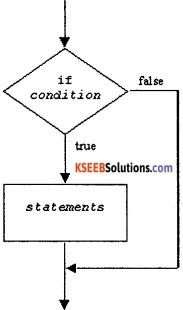
Write the flowchart representation of ‘if’ statement.
Answer:
1st PUC Computer Science Question Bank Chapter 10 Control Statements 1

Question 5.
Write the syntax of ‘if-else’ statement.
Answer:
1st PUC Computer Science Question Bank Chapter 10 Control Statements 2

Question 6.
Write the flowchart representation of ‘if-else’ statement.
Answer:
1st PUC Computer Science Question Bank Chapter 10 Control Statements 3

Question 7.
Write the syntax of if-else-if statement.
Answer:
1st PUC Computer Science Question Bank Chapter 10 Control Statements 4

Question 8.
Write the flowchart representation of ‘if-else-if’ conditional structure.
Answer:
1st PUC Computer Science Question Bank Chapter 10 Control Statements 5

Question 9.
Write the syntax of‘switch-case’ statement.
Answer:
1st PUC Computer Science Question Bank Chapter 10 Control Statements 6

Question 10.
Write the comparison between ‘if-else’ and ‘switch-case’ statement.
Answer:
The ‘if-else’ statements permit two-way branching, whereas ‘switch’ statement permits multiple branching.

Question 11.
Write the syntax of ‘while’ loop.
Answer:
Syntax of ‘while’ loop:
while(condition)
{
statement(s);
}

KSEEB Solutions

Question 12.
Write the syntax of ‘do-while’ loop.
Answer:
Syntax of ‘do-while’ loop
do
{
statements;
} while (condition);

Question 13.
Write the flowchart of representation of while loop.
Answer:
1st PUC Computer Science Question Bank Chapter 10 Control Statements 7

Question 14.
Write the flowchart representation of ‘do-while’ loop.
Answer:
1st PUC Computer Science Question Bank Chapter 10 Control Statements 8

Question 15.
Give the difference between ‘break’ and ‘exit()’ statements.
Answer:
The ‘break’ statement can be used to terminate a repeated structure (loops) such as ‘while’, do-while and for and multi-branching statements like ‘switch’.
The execution of a program can be stopped at any point with ‘exit ( )’.

Question 16.
Give the difference between ‘goto’ statement and ‘continue’ statement.
Answer:
The ‘goto’ statement transfers/jump control from one part of the program some other part. The ‘continue’ statement is used in loops and causes a program to skip the rest of the body of the loop.

1st PUC Computer Science Control Statements Five Marks Questions and Answers

Question 1.
Explain the working of ‘ if’ statement and ‘if-else’ statement with examples.
Answer:
Example for ‘if’ statement:
1st PUC Computer Science Question Bank Chapter 10 Control Statements 9
Result:
B is greater than A
In the above example the condition in the if statement returns a true value and so the text “B is greater than A” is displayed.
Example for ‘if else’ statement:
1st PUC Computer Science Question Bank Chapter 10 Control Statements 10
Result:
B is greater than A.
In the above example, the “if’ condition is false so the code in the “else” part is executed.

KSEEB Solutions

Question 2.
Explain the working of if-else if statement with a suitable example.
Answer:
The ‘if-else if’ statement is an extension of the “if-else” conditional branching statement. When the expression in the “if’ condition is “false” another “if-else” construct is used to execute a set of statements based on the expression.
Syntax:
if(expression)
{ statements }
else if(expression)
{ statements }
else if(expression)
{ statements }
Example: for ‘if else if’ statement
1st PUC Computer Science Question Bank Chapter 10 Control Statements 11
1st PUC Computer Science Question Bank Chapter 10 Control Statements 11a
Result:
Enter your Percentage::60
First Class
In the above example, the ‘if else if’ statement is used to check multiple conditions based on the percentage of marks got, as input. The user entered percentage as 60, then first condition evaluated and returned with false. This resulted in checking for second if condition and resulted in true which give the print “first class”.

Question 3.
Write a short note on ‘switch-case’ statement.
Answer:
A ‘switch’ statement allows a variable to be tested for equality against a list of values. Each value is called a case, and the variable being switched on is checked for each case.
Syntax:
The syntax for a switch statement:
switch(expression)
{
case constant-expression : statement(s);
break; //optional
case constant-expression : statement(s);
break; //optional
default                              : statement(s);                 //Optional
}
The following rules apply to a switch statement:

  1. The expression used in a ‘switch’ statement must have an integer or enumerated type.
  2. We can have any number of case statements within a ‘switch’. Each case is followed by the value to be compared to, and a colon.
  3. The constant-expression for a case must be the same data type as the variable in the ‘switch’,
    and it must be a constant or a literal.
  4. When the variable being switched on is equal to a case, the statements following that case will execute until a ‘break’ statement is reached.
  5. When a ‘break’ statement is reached, the ‘switch’ terminates, and the flow of control jumps to the next line following the ‘ switch ’ statement.
  6. Not every case needs to contain a break. If no break appears, the flow of control will fall through to subsequent cases until a ‘break’ is reached.
  7. If no conditions match, then the code under the default statement is executed.
  8. The default case is used for performing a task when none of the cases is ‘true’.
  9. No break is needed in the default case.

KSEEB Solutions

Question 4.
Explain ‘switch-case’ statement with a suitable program example.
Answer:
‘ Switch’ statement compares the value of an expression against a list of integers or character constants. The list of constants are listed using the “case” statement along with a “break” statement to end the execution.
Example:
1st PUC Computer Science Question Bank Chapter 10 Control Statements 12
1st PUC Computer Science Question Bank Chapter 10 Control Statements 13
Result:
Enter the day of the week between 1-7::7
Sunday
In the above Control Structure example, the “switch” statement is used to find the day of the week from the integer input got from the user. The value present in the day is compared for equality with constants written in the word case. Since no equality is achieved in the above example (from 1 to 6), when 7 is entered default is selected and gives “Sunday” as a result.

Question 5.
Explain ‘while’ loop structure with an example.
Answer:
A ‘while’ loop statement repeatedly executes a statement or sequence of statements written in the flower brackets as long as a given condition returns the value ‘true’.
Syntax:
The syntax of a ‘while’ loop in C++ is:
while(condition)
{
statement (s) ;
}
Here the condition may be any expression, and for true is any non zero value. The loop iterates while the condition is true. When the condition becomes false, program control passes to the line immediately following the loop. During the first attempt, when the condition is tested and the result is false, the loop body will be skipped and the first statement after the ‘while’ loop will be executed.
Example:
1st PUC Computer Science Question Bank Chapter 10 Control Statements 14
When the above code is executed, it produces the following result:
value of a: 10
value of a: 11
value of a: 12
value of a: 13
value of a: 14

KSEEB Solutions

Question 6.
Explain the working of ‘for’ loop structure.
Answer:
A ‘for’ loop is a repetition control structure, that allows you to efficiently write a loop that needs to execute a specific number of times.
Syntax:
The syntax of a ‘for’ loop in C++ is:
for (initialization; condition; increment/decrement)
{
statement(s);
}
The working of a ‘for’ loop:

  1. The initialization step is executed first, and only once in the beginning. It is used to declare and initialize loop control variables.
  2. Next, the condition is evaluated. If it is true, the body of the loop is executed. If it is false, the body of the loop does not execute and the flow of control jumps to the next statement just after the ‘for’ loop.
  3. After the body of the ‘for’ loop executes, the flow of control jumps back up to the increment/ decrement statement and update any ‘loop’ control variables.
  4. Then the condition is evaluated again. If it is true, the ‘ loop’ executes and the process repeats itself (body of ‘loop’, then increment step, and then again condition). After the condition becomes false, the ‘for’ loop terminates.

Example:
1st PUC Computer Science Question Bank Chapter 10 Control Statements 15
When the above code is compiled and executed, it produces following result:
value of a: 10
value of a: 11
value of a: 12
value of a: 13
value of a: 14
value of a: 15

KSEEB Solutions for Class 3 EVS Chapter 13 Facilities for Our Use in Kannada

Students can Download EVS Chapter 13 Facilities for Our Use Questions and Answers, Notes Pdf, KSEEB Solutions for Class 3 EVS in Kannada helps you to revise the complete Karnataka State Board Syllabus and score more marks in your examinations.

Karnataka State Syllabus Class 3 EVS Chapter 13 Facilities for Our Use in Kannada

KSEEB Class 3 EVS Facilities for Our Use Text Book Questions and Answers

KSEEB Solutions for Class 3 EVS Chapter 13 Facilities for Our Use in Kannada 1
KSEEB Solutions for Class 3 EVS Chapter 13 Facilities for Our Use in Kannada 2

KSEEB Solutions for Class 3 EVS Chapter 13 Facilities for Our Use in Kannada 3
KSEEB Solutions for Class 3 EVS Chapter 13 Facilities for Our Use in Kannada 4
KSEEB Solutions for Class 3 EVS Chapter 13 Facilities for Our Use in Kannada 5
KSEEB Solutions for Class 3 EVS Chapter 13 Facilities for Our Use in Kannada 6

KSEEB Solutions for Class 3 EVS Chapter 13 Facilities for Our Use in Kannada 7
KSEEB Solutions for Class 3 EVS Chapter 13 Facilities for Our Use in Kannada 8
KSEEB Solutions for Class 3 EVS Chapter 13 Facilities for Our Use in Kannada 9

KSEEB Solutions for Class 3 EVS Chapter 13 Facilities for Our Use in Kannada 10
KSEEB Solutions for Class 3 EVS Chapter 13 Facilities for Our Use in Kannada 11
KSEEB Solutions for Class 3 EVS Chapter 13 Facilities for Our Use in Kannada 12

KSEEB Solutions for Class 3 EVS Chapter 13 Facilities for Our Use in Kannada 13
KSEEB Solutions for Class 3 EVS Chapter 13 Facilities for Our Use in Kannada 14
KSEEB Solutions for Class 3 EVS Chapter 13 Facilities for Our Use in Kannada 15

KSEEB Solutions for Class 10 Maths Chapter 9 Polynomials Additional Questions

Students can Download Class 10 Maths Chapter 9 Polynomials Additional Questions, Notes Pdf, KSEEB Solutions for Class 10 Maths helps you to revise the complete Karnataka State Board Syllabus and score more marks in your examinations.

Karnataka State Syllabus Class 10 Maths Chapter 9 Polynomials Additional Questions

I. Multiple Choice Questions:

Question 1.
The degree of polynomial is x + 2
a. 2
b. 1
c. 3
d. 4
Answer:
b. 1

KSEEB Solutions for Class 10 Maths Chapter 9 Polynomials Additional Questions

Question 2.
The degree of a quadratic polynomial is
a. 0
b. 1
c. 2
d. 3
Answer:
c. 2

Question 3.
The degree polynomial of a bi-quadratic
a. 0
b. 2
c. 4
d. 1
Answer:
c. 4

Question 4.
The standard polynomial. form of a linear
a. ax + c
b. ax2 + c
c. ax2 + bx + c = 0
d. ax3 + bx2 + cx + d = 0
Answer:
a. ax + c

Question 5.
The standard form of a quadratic equation.
a. ax2 + bx + c = 0
b. ax + c = 0
c. ax2 + c = 0
d. ax3 + bx + c = 0
Answer:
a. ax2 + bx + c = 0

Question 6.
A polynomial of degree 3 is called
a. a linear polynomial
b. a quadratic polynomial
c. a cubic polynomial
d. a biquadratic polynomial
Answer:
c. a cubic polynomial

KSEEB Solutions for Class 10 Maths Chapter 9 Polynomials Additional Questions

Question 7.
The value of px. = x2 – 3x – 4, x = -1
a. 1
b. – 4
c. 0
d. – 3
Answer:
c. 0

Question 8.
The degree of the polynomial x4 + x3 is
a. 2
b. 3
c. 5
d. 4
Answer:
d. 4

Question 9.
The number of zeroes of linear polynomial at most is
a. 0
b. 1
c. 2
d. 3
Answer:
b. 1

Question 10.
The degree of polynomial x + 2. x + 1. is
a. 1
b. 3
c. 4
d. 2
Answer:
d. 2

Question 11.
The degree of a zero polynomial is
a. not defined
b. 1
c. 2
d. 3
Answer:
a. not defined

Question 12.
The zeroes of the polynomial x3 -4x are
a. 0, ± 2
b. 0, ± 1
c. 0, ± 3
d. 0, 0
Answer:
a. 0, ± 2

Question 13.
The zeroes of the polynomials, t2 – 15 are.
a. ± \(\sqrt{15}\)
b. ± \(\sqrt{5}\)
c. ± \(\sqrt{3}\)
d. ± 3
Answer:
a. ± \(\sqrt{15}\)

KSEEB Solutions for Class 10 Maths Chapter 9 Polynomials Additional Questions

Question 14.
Dividend is equal to.
a. divisor × quotient + remainder
b. divisor × quotient
c. divisor × quotient – remainder
d. divisor × quotient × remainder
Answer:
a. divisor × quotient + remainder

Question 15.
If the divisor is x2 and quotient is x while the number remainder is 1, then the dividend is.
a. x2
b. x
c. x3
d. x3 + 1
Answer:
d. x3 + 1

Question 16.
What is the co-efficient of the first term of the quotient when 2x2 + 2x + 1 is divided by x + 2?
a. 1
b. 2
c. 3
d. – 2
Answer:
b. 2

Question 17.
The zeroes of the polynomial x2 – 3x – 4 are
a. 4, – 1
b. 4, 1
c. – 4, 1
d.- 4, – 1
Answer:
a. 4, – 1

Question 18.
If f(x) = x2 – 1 the value of f(2) is
a. 1
b. 3
c. 4
d. 0
Answer:
b. 3

Question 19.
If f(x) = 8 f(x) is called
a. Constant polynomials
b. linear polynomials
c. quadratic polynomials
d. Cubic polynomials
Answer:
a. Constant polynomials

KSEEB Solutions for Class 10 Maths Chapter 9 Polynomials Additional Questions

Question 20.
A cubic polynomial has at most
a. 1 zeroes
b. 2 zeroes
c. 3 zeroes
d. 4 zeroes.
Answer:
c. 3 zeroes

II. Short Answer Questions:

Question 1.
Find the value of P(x) = x2 + 2x – 5 at x = 1
Answer:
P(x) = x2 + 2x – 5
P (1) = (1)2 + 2(1) – 5 = 1 + 2 – 5
= 3 – 5
P(1) = – 2

Question 2.
If x = 1 is a zero of the Polynomial f(x) = x3 – 2x2 + 4x + K, write the value of K.
Answer:
f(x) = x3 – 2x2 + 4x + K x = 1
f(1) = (1)3 – 2(1)2 + 4(1) + K
f(1) = 0 zero of the polynomial
0 = 1 – 2 + 4 + K
0 = 3 + K
K = – 3

Question 3.
If α and β are zeroes of Polynomials P(x) = x2 – 5x + 6, then find the value of α + β – 3αβ.
Answer:
α + β = \(\frac{-b}{a}=\frac{-(-5)}{1}\) = 5 and
αβ = \(\frac{c}{a}=\frac{6}{1}\) = 6
α + β – 3αβ
= 5 – 3(6)
= 5 – 18 = -13
α + β – 3αβ = – 13

KSEEB Solutions for Class 10 Maths Chapter 9 Polynomials Additional Questions

Question 4.
Find the zeroes of the Polynomial P(x) = 4x2 – 12x + 9
Answer:
KSEEB Solutions for Class 10 Maths Chapter 9 Polynomials Additional Questions 1
P(x) = 4x2 – 12x + 9
4x2 – 6x – 6x + 9 = 0
2x(2x – 3) – 3(2x – 3) = 0
(2x – 3) (2x – 3) = 0
x = \(\frac{3}{2}\), \(\frac{3}{2}\)

Question 5.
If 1 is a zero of the Polynomial P(x) = ax2 – 3(a – 1) x – 1, then find the value of a.
Answer:
P(x) = ax2 – 3(a – 1) x – 1
∴ x = 1
P(1) = a(1)2 – 3(a – 1) 1 – 1
P(1) = a – 3a + 3 – 1
0 = – 2a + 2
2a = 2
a = \(\frac{2}{2}\) = 1
a = 1

Question 6.
Write the degree of the Polynomial 3x3 – x4 + 5x + 3
Answer:
3x3 – x4 + 5x + 3
– x4 + 3x3 + 5x + 3
∴ degree of the Polynomial is 4

Question 7.
Write the standard form of a cubic Polynomial.
Answer:
ax3 + bx3 + cx + d.

Question 8.
Find the zero of the Polynomial , P(x) = a2x, a ≠ 0
Answer:
P(x) = a2x
a2x = 0
x = \(\frac{0}{a^{2}}\)
x = 0

Question 9.
If α and β are the zeroes of the polynomial 4x2 + 3x + 7, then find the value of \(\frac{1}{\alpha}+\frac{1}{\beta}\)
Answer:
KSEEB Solutions for Class 10 Maths Chapter 9 Polynomials Additional Questions 2

III. Long Answer Questions:

Question 1.
Find the zeroes of the following quadratic polynomials x2 + 4x + 4.
Answer:
f(x) = x2 + 4x + 4
0 = x2 + 2x + 2x + 4
0 = x(x + 2) + 2(x + 2)
(x + 2) (or) (x + 2) = 0
x + 2 = 0 (or) x + 2 = 0
x = – 2 x = – 2.
Zeroes of the Polynomials x2 + 4x + 4 are – 2 and – 2

KSEEB Solutions for Class 10 Maths Chapter 9 Polynomials Additional Questions

Question 2.
If x = 1 is a zero of the polynomial f(x) = x3 – 2x2 + 4x + K, find the value of K.
Answer:
f(x) = x3 – 2x2 + 4x + K
∴ x = 1
f(x) = (1)3 – 2(1)2 + 4(1) + K
0 = 1 – 2(1) + 4 + K [f(1) = 0]
0 = 1 – 2 + 4 + K.
K + 3 = 0
K = – 3

Question 3.
For what value of K, – 4 is a zero of the polynomial x2 – x – (2K + 2)?
Answer:
f(x) = x2 – x – (2K + 2) and f(x) = 0
x = – 4
f(- 4) = (- 4)2 (- 4) – (2K + 2)
0 = 16 + 4 – 2K – 2
20 – 2 – 2K = 0 ⇒ 18 = 2K
K = \(\frac{18}{2}\) ⇒ K = 9

Question 4.
Divide p(x) by g(x) in each of the following cases and verify division algorithm.
P(x) = x2 + 4x + 4, g(x) = x + 2
Answer:
x2 + 4x + 4 ÷ x + 2
KSEEB Solutions for Class 10 Maths Chapter 9 Polynomials Additional Questions 3
q(x) = x + 2 and r(x) = 0

Question 5.
On dividing the polynomial. P(x) = x3 – 3x2 + x + 2 by a polynomial g(x) the quotient and remainder were (x – 2) and (- 2x + 4) respectively. Find g(x).
Answer:
P(x) = x3 – 3x2 + x + 2
q(x) = (x – 2); r(x) = (- 2x + 4)
g(x) = ?
KSEEB Solutions for Class 10 Maths Chapter 9 Polynomials Additional Questions 4
g(x) = x2 – x + 1; r(x) = 0
∴ The divisor is x2 – x + 1

KSEEB Solutions for Class 10 Maths Chapter 9 Polynomials Additional Questions

Question 6.
What must be subtracted from x3 + 5x2 + 5x + 8 so that the resulting polynomial is exactly divisible by x2 + 3x – 2?
Answer:
P(x) = x3 + 5x2 + 5x + 8
g(x) = x2 + 3x – 2
P(x) = g(x) q(x) + r(x)
KSEEB Solutions for Class 10 Maths Chapter 9 Polynomials Additional Questions 5
q(x) = x + 2; r(x) = x + 12
If we subtract x + 12 from x3 + 5x2 + 5x + 8 it will be exactly divisible by x2 + 3x – 2

Question 7.
What should be added to (x4 – 1) so that it’ is exactly divisible by (x2 + 2x + 1)?
Answer:
P(x) = x4 – 1 g(x) = x2 + 2x + 1
x4 + 0x3 + 0x3 + 0x – 1
KSEEB Solutions for Class 10 Maths Chapter 9 Polynomials Additional Questions 6
r(x) = – 4x – 4
– {r(x)} = {4x + 4}

Question 8.
If the polynomials 2x3 + ax2 + 3x – 5 and x3 + x2 – 4x – a leave the same remainder when divided by x – 1 find the value of a.
Answer:
x – 1 = 0 [∴ g(x) = (0)]
x = 1
P(x) = 2x3 + ax2 + 3x – 5
P(1) = 2(1)3 + a(1)3 + 3(1) – 5
P(1) = 2 + a + 3 – 5
P(1) = a ➝ (1)
g(x) = x3 + x2 – 4x – a
g(1) = (1)3 + (1)2 – 4(1) – a
= 1 + 1 – 4 – a
g(x) = – 2 – a ➝ (2)
g(1) = g(1) [∴ Polynomials are leave same remainder]
a = – 2 – a
a + a = – 2
2a = – 2
a = \(\frac{-2}{2}\)
a = – 1

Question 9.
If (x3 + ax2 – bx + 10) is divisible by x3 – 3x + 2, find the values of a and b.
Answer:
P(x) = x3 + ax2 – bx + 10
g(x) = x2 – 3x + 2
x2 – 2x – x + 2 = 0
x(x – 2) – 1(x – 2) = 0
(x – 2) (x – 1) = 0
x = 2 and x = 1
P(x) = x3 + ax2 – bx + 10
P(x) = (1)3 + a(1)2 – b(1) + 10
= 1 + a – b + 10
0 = a – b + 11
a – b = – 11 ➝ (1)
P(2) = (2)3 + a(2)2 – b(2) + 10
P(2) = 8 + 4a – 2b – 10
0 = 4a – 2b + 18
4a – 2b = – 18 ➝ (2)
Multiply equation (1) by 4 and subtract with equation (2)
KSEEB Solutions for Class 10 Maths Chapter 9 Polynomials Additional Questions 7
b = 13
Put b = 13 in equation (1)
a – b = – 11
a – 13 = – 11
a = – 11 + 13
a = 2

KSEEB Solutions for Class 10 Maths Chapter 9 Polynomials Additional Questions

Question 10.
If both x – 2 and x – \(\frac{1}{2}\) are factors of ax2 + 5x + b show that a = b.
Answer:
P(x) = ax2 + 5x2 + b
x – 2 = 0
x = 2
P(x) = ax2 + 5x + b
P(2) = a(2)2 + 5(2) + b
0 = 4a + 10 + b ➝ (1)
P(x) = ax2 + 5x + b
x – \(\frac{1}{2}\) = 0
x = \(\frac{1}{2}\)
P(x) = ax2 + 5x + b
KSEEB Solutions for Class 10 Maths Chapter 9 Polynomials Additional Questions 8
a = – 2 ➝ (3)
Put a = – 2 in equation (1)
4a – 10 + b = 0
4(- 2) + 10 + b = 0
– 8 + 10 + b = 0
2 + b = 0
b = -2 ➝ (4)
From (3) and (4)
a = b.

Question 11.
If α and β are the zeroes of the quadratic polynomials f(x) = 2x2 – 5x + 7, find a polynomial whose zeroes are 2α + 3β and 3α + 2β.
Answer:
Since α and β are the zeroes of the quadratic polynomial f(x) = 2x2 – 5x + 7.
KSEEB Solutions for Class 10 Maths Chapter 9 Polynomials Additional Questions 9
Let S and P denote respectively the sum and product of the zeroes of the required polynomial.
Then, S = (2α + 3β) + (3α + 2β)
= 5(α + β) = 5 × \(\frac{5}{2}=\frac{25}{2}\) and
P = (2α + 3β) (3α + 2β)
⇒ P = (6α2 + 6β2 + 13αβ)
= 6α2 + 12αβ + αβ + 6β2
⇒ P = 6(α2 + β2 + 2αβ + αβ
= 6(α + β)2 + αβ
= 6(α2 + β2 + 2αβ) + αβ
= 6(α + β)2 + αβ
KSEEB Solutions for Class 10 Maths Chapter 9 Polynomials Additional Questions 10
Hence the required polynomial g(x) is given by
g(x) = K(x2 – 5x + P)
or g(x) = K\(\left(x^{2}-\frac{25}{2} x+41\right)\), where K and any non zero real number.

Question 12.
If α and β are the zeroes of the polynomial. 6y2 – 7y + 2, find a quadratic polynomial whose zeroes are \(\frac{1}{\alpha}\) and \(\frac{1}{\beta}\).
Answer:
Let P(y) = 6y2 – 7y + 2
KSEEB Solutions for Class 10 Maths Chapter 9 Polynomials Additional Questions 11

KSEEB Solutions for Class 10 Maths Chapter 9 Polynomials Additional Questions

Question 13.
If one zero of the polynomial 3x2 – 8x + 2k + 1 and seven times the other, find the value of k.
Answer:
Let α and β be the zeroes of the polynomial. Then as per question β = 7α.
Now sum of zeroes = α + β = α + 7α
KSEEB Solutions for Class 10 Maths Chapter 9 Polynomials Additional Questions 12

Question 14.
If one zero of polynomial (a2 + 9)x2 + 13x + 6a and reciprocal of the other, find the value of a.
Answer:
Let one zero of the given polynomial be α
Then, the other zero and \(\frac{1}{\alpha}\)
∴ Product of zeroes = α × \(\frac{1}{\alpha}\) = 1
But, as per the given polynomial product of Zeroes = \(\frac{6 a}{a^{2}+9}\)
∴ \(\frac{6 a}{a^{2}+9}\) = 1 ⇒ a2 + 9 = 6a
⇒a2 – 6a + 9 = 0 ⇒ (a – 3)2 = 0
⇒ a – 3 = 0 ⇒ a = 3
Hence a = 3.

Question 15.
Find the zeroes of the polynomial f(x) = x3 – 5x2 – 2x + 24 if it is given that the product of its two zeroes is 12.
Answer:
Let α, β and γ be the zeroes of polynomial f(x) such that αβ = 12
KSEEB Solutions for Class 10 Maths Chapter 9 Polynomials Additional Questions 13
Putting αβ = 12 in αβγ = – 24 we get
12γ = – 24 ⇒ γ = \(\frac{-24}{12}\) = – 2
Now α + β + γ = 5 ⇒ α + β – 2 = 5
⇒ α + β = 7
⇒ α = 7 – β
∴ αβ =12
⇒ (7 – β) β = 12
⇒ 7β = β2 = 12
⇒ β2 – 7β + 12 = 0
⇒ β2 – 3β – 4β – 12 = 0
⇒β(β -3) – 4(β – 3) = 0
⇒(β -4)(β – 3) = 0
⇒ β = 4 or β = 3
α = 3 or α = 4.

Question 16.
If α, β, γ be zeroes of polynomial 6x3 + 3x2 – 5x +1, then find the value of α– 1 + β– 1 + γ– 1
Answer:
P(x) = 6x3 + 3x2 – 5x + 1 so
a = 6, b = 3, c = – 5, d = 1
∴ α, β and γ are zeroes of the polynomial p(x)
KSEEB Solutions for Class 10 Maths Chapter 9 Polynomials Additional Questions 14

KSEEB Solutions for Class 10 Maths Chapter 9 Polynomials Additional Questions

error: Content is protected !!